Archives for category: Uncategorized

Yesterday, after two months of solid rain, the sun came out and we took the opportunity to visit our muddy building site.

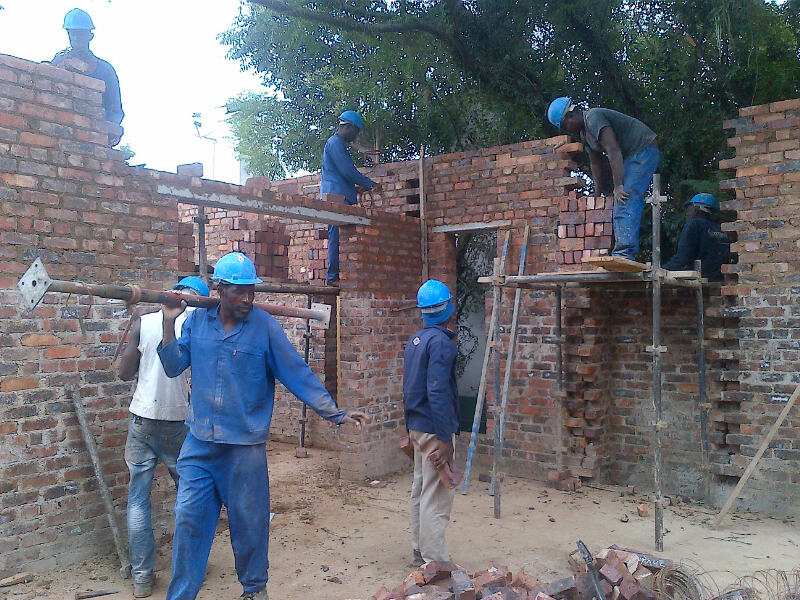
Although quite a lot of progress has been made in laying the lintels which will make up the first floor slab, there is not a lot of visible progress to see since our last site meeting and the forest of steel poles supporting the lintels make moving around the house quite difficult.  All the bricks for the building of the second floor have been delivered and are waiting on site.

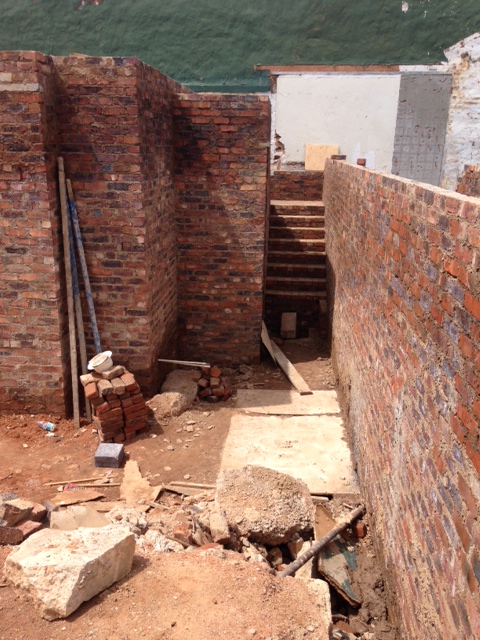
Work has begun on the staircase that will lead up to the suite of rooms above the garage:

The start of stairs leading to rooms above the garage.

The start of stairs leading to rooms above the garage.

The patio pillars which will support the upstairs balcony have also been put in place.  Downpipes to take water run-off from upstairs are hidden within these pillars.

Patio Pillars encasing rainwater downpipes.

Patio Pillars encasing rainwater downpipes.

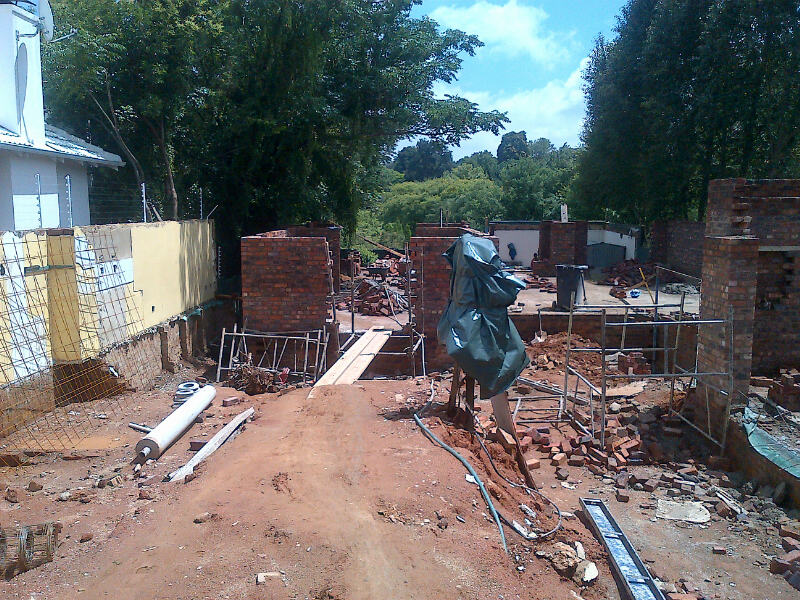
We haven’t been able to access the house through the front door opening for months.  The heaps of building rubble and treacherous mounds of mud have made the approach virtually impassable.  Instead we have to cross a plank bridge to the opening that will one day be French doors leading out of the library.

Walking the Plank.

Walking the Plank.

I’m not sure what I’m looking forward to more; seeing the walls of the second storey go up or seeing the driveway graded.  I think the contractor’s priority is getting the walls up.  Yesterday I was simply relieved to see sunshine on the site again.  It was shortlived though.  Rain is forecast for the rest of the week.

xxxxxxxxxxxxxxxxxxxxxxxxxxxxxxxxxxxxxxxxxxxxxxxxxxxxxxxxxxxxxxxxxx

February was a funny month.  Plagued by rain, including several thunderstorms which dumped vast quantities of water on the site in the space of half and hour or less, progress was slower than expected.  Here is a quick photographic update of where we are now on the 1st of March.  I’d like to believe that the dry, more mellow days of Autumn are around the corner, but if the steady rain today is anything to go by, that would be foolishly optimistic.

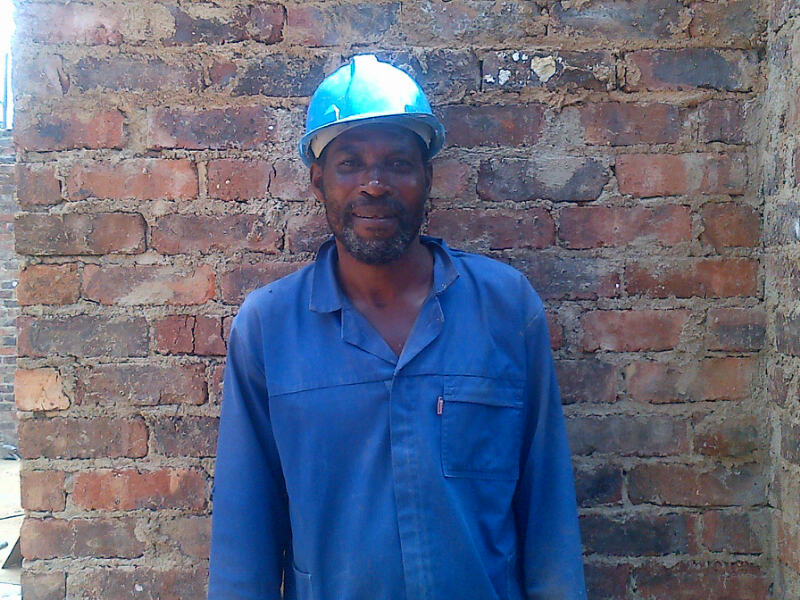
Albert, our head builder.

Albert, our head builder.

Albert is on site everyday and participates in the weekly site meetings.  He seems to manage and co-ordinate all the other workers quietly and without fuss.

Rupert, our site manager.

Rupert, our site manager.

Rupert is often on the site but also takes care of small collections and deliveries of materials.

Fireplace in the making.

Fireplace in the making.

The fireplace is going on the west wall of the living room with a sash window on either side.

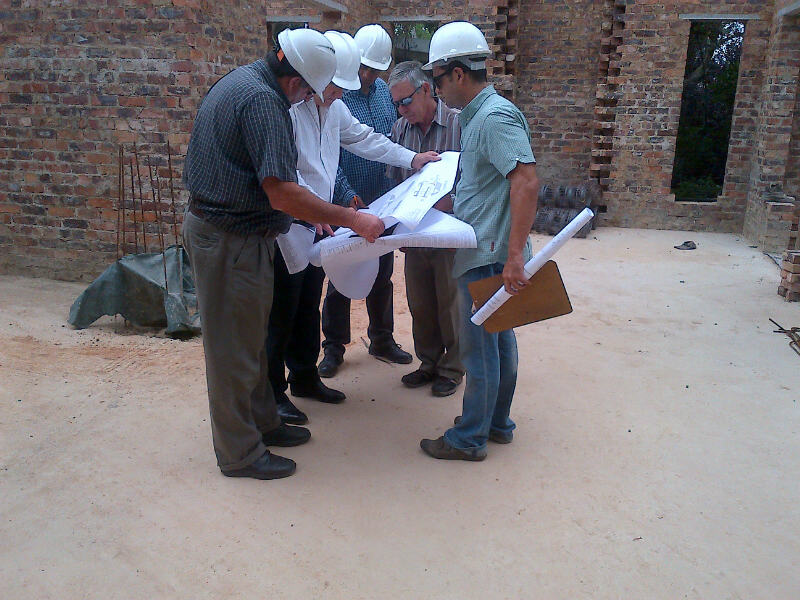
Consulting.

Consulting.

A makeshift table.

A makeshift table.

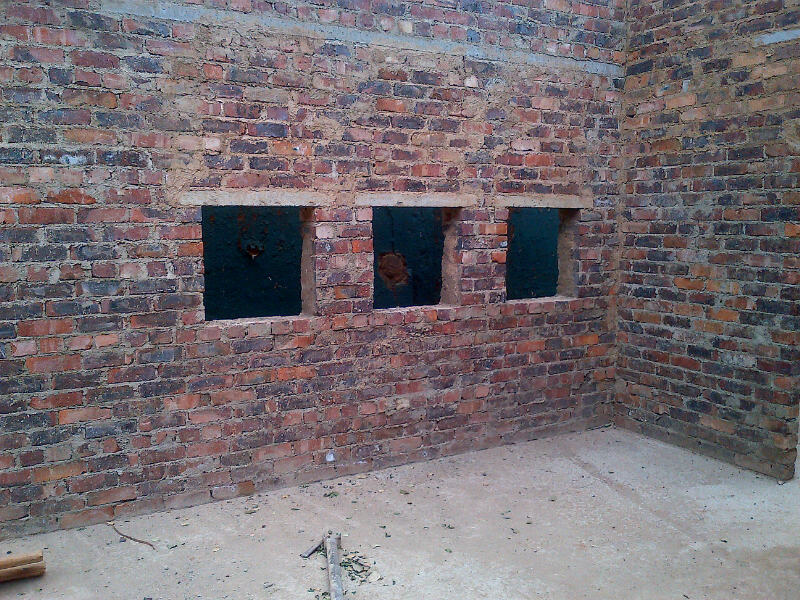
Windows between lower and upper kitchen cupboards.

Windows between lower and upper kitchen cupboards.

These windows will be able to be opened.  The eastern boundary wall is very close to the kitchen so I’m on the lookout for interesting garden wall features.

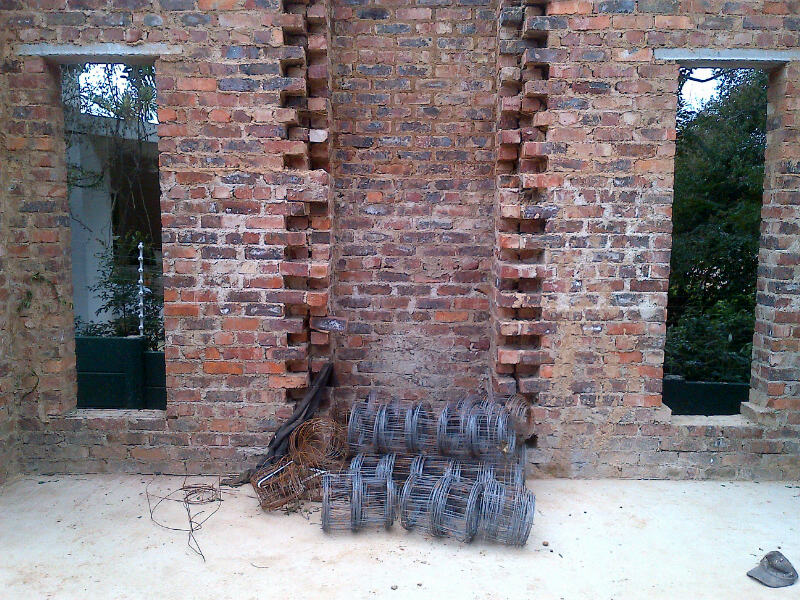
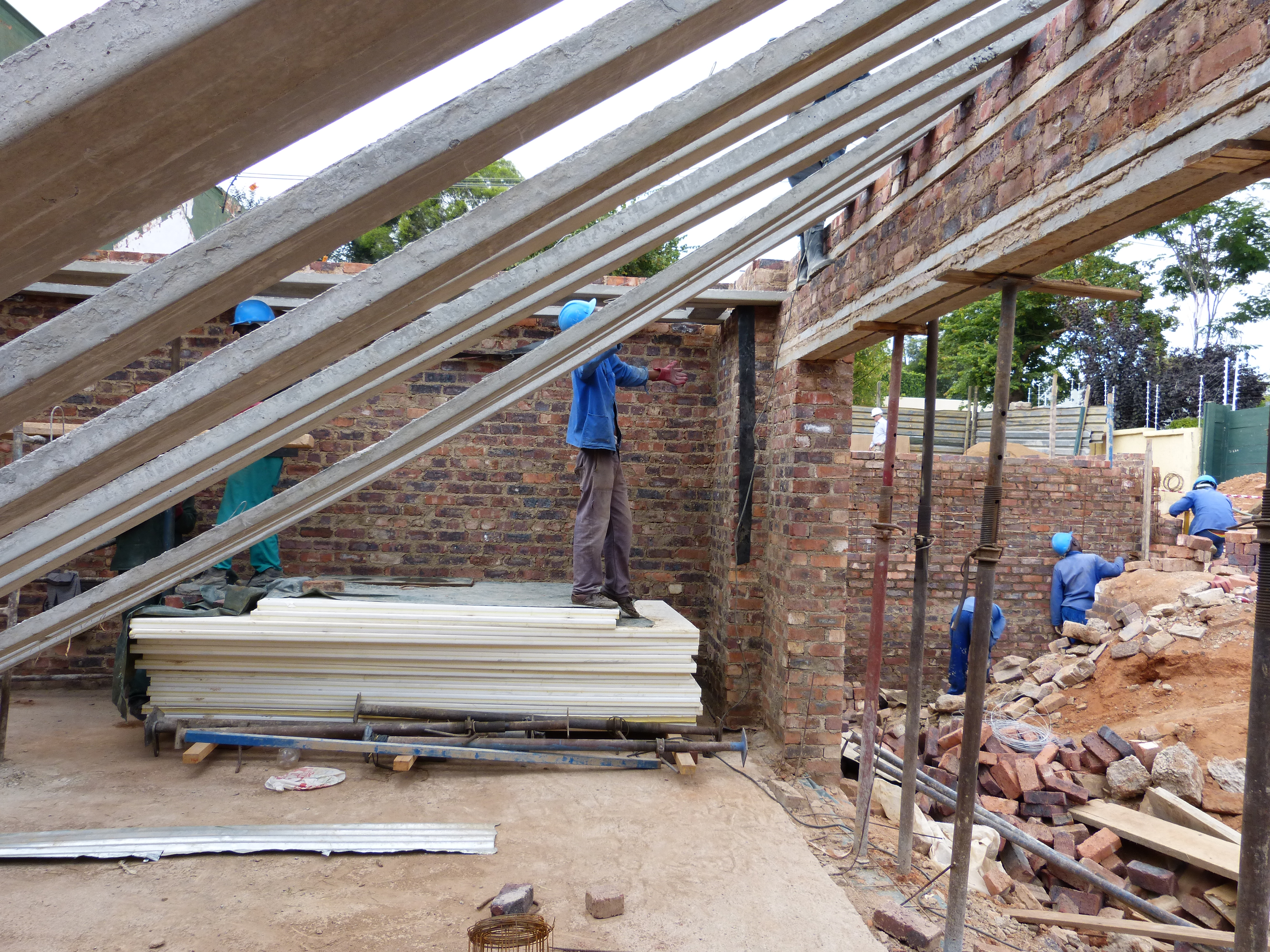
Concrete lintels for the first floor have arrived.

Concrete lintels for the first floor have arrived.

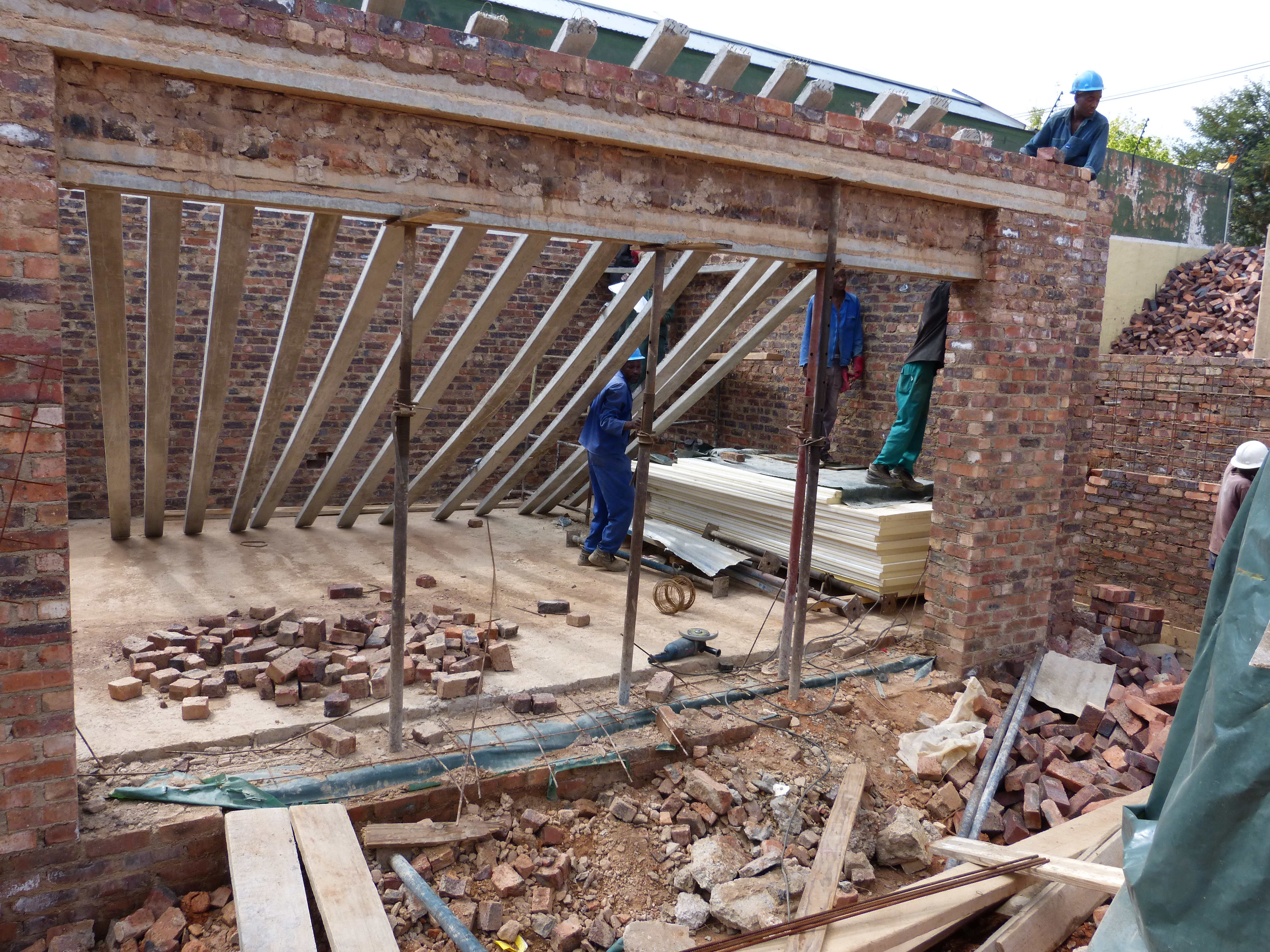
The first floor slab is made up of concrete lintels with blocks that interlock with them in some way.  Other than in the garage, on the ground floor we are having plastered ceilings below the slab.

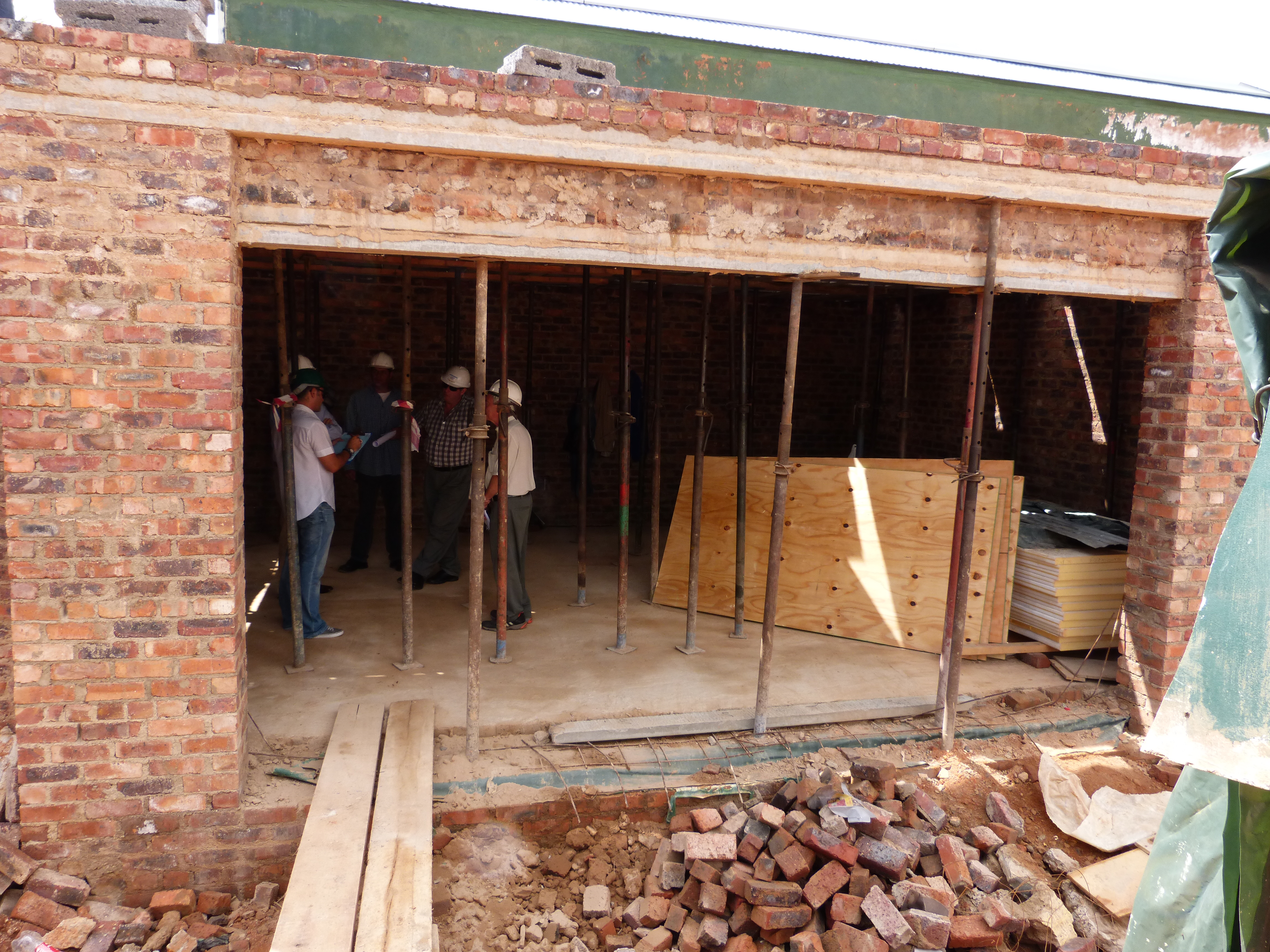
My brother (an architect), and my sister-in-law (with an eye for design) from Cape Town doing an impromptu site inspection.

My brother (an architect), and my sister-in-law (with an eye for design) from Cape Town doing an impromptu site inspection.

Retaining wall going up on North side of cottage.

Retaining wall going up on North side of cottage.

The retaining wall which is being built down the west side and across north side of the cottage is one feature that has been altered during the construction process.  The engineer decided it should be a double core wall.  This comprises two identical walls built parallel to each other.  The space between the two wall is filled with concrete and a special, porous waterproof membrane in incorporated to diffuse water rather than have it build up against the brickwork.  Looking at the work in progress one could be forgiven to thinking we were building a fort.  Hopefully all this extra effort will prevent the cottage from sliding down onto the house below – even if this rain never stops.

Lintels ready to be raised into position.

Lintels ready to be raised into position.

In South African brick-built houses,the  first floor is often made up of concrete lintels interlocked with blocks.  Sometimes the ceiling of the ground floor is simply the plastered, painting underside of these lintels.  In our case, we’re putting in plastered ceiling board 150mm below the slab.  Electrical wiring, transformers for downlights etc can then be fitted between the slab and the ceiling board.  This allows for changes to be made later too if you decide you need more fittings at a later stage.

Concrete lintels in place above garage. February 27th.

Concrete lintels in place above garage. February 27th.

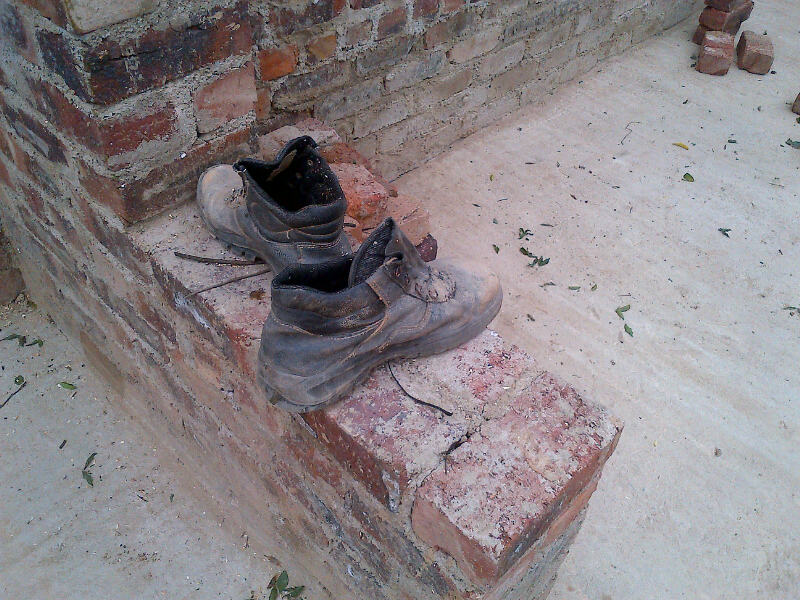
Almost each time I visit the site, I find some sort of random ‘still life’ arrangement that looks like a painting waiting to happen.  Below is an example:

Boots made for Working.

Boots made for Working.

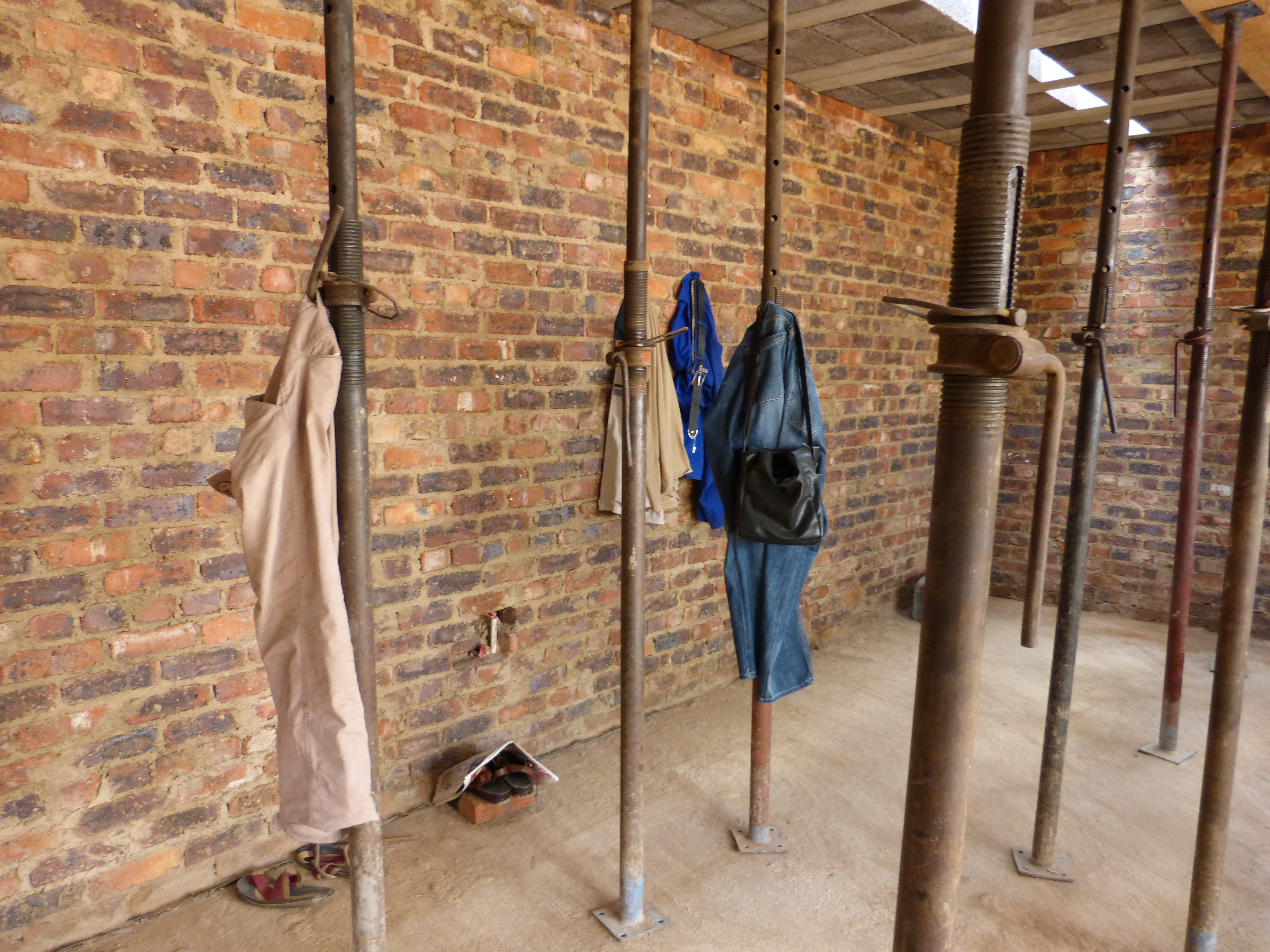
And I love the way every effort is made to keep clothes tidy in the simplest of ways:

Hanging Space!

Hanging Space!

Hopefully the garage will soon be able to be used for storage and for keeping clothes and building materials dry.  When is this rain going to stop?  I’m thinking of buying gumboots.

Arriving back in Johannesburg after a full month away in Cape Town is always something of a shock.  We drove back, covering the 1200 kilometres two days and breaking the journey at one of our favourite Karoo farm stops.  One of the benefits of the long road trip is the opportunity to change up a gear from the more laid-back (and much better organised) Cape, to the frenetic, unpredictable energy of Gauteng.  But despite all those hours on the road, exiting the motorway and finding oneself back on Oxford Road in Forest Town still pulls one up short.  The traffic lights are malfunctioning and the challenge of trying to avoid all the potholes brings one back quickly to the reality of Johannesburg.  This time we drove in under looming, threatening thunder clouds which lent a disconcerting sense of impending doom to the afternoon and one of my first thoughts was ‘Why on earth are we building another house here?’

But you’ve got to live in Johannesburg to love it.  It has its own unique and stealthy charm and within a day of getting back, I’m happy once again to be here and this year is no different.  By Tuesday morning we were ready to inspect our building site and to check on any progress that may have been made in the builders’ first week back at work.

This is a quick photograph update for interested faraway family and friends:

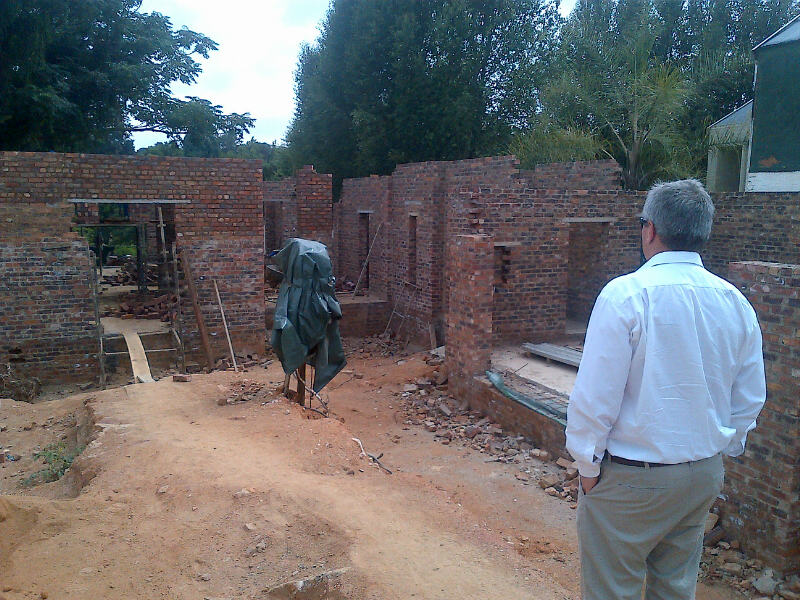
Surveying the Situation...  After a month away.

Surveying the Situation… After a month away.

IMG-20140121-00524

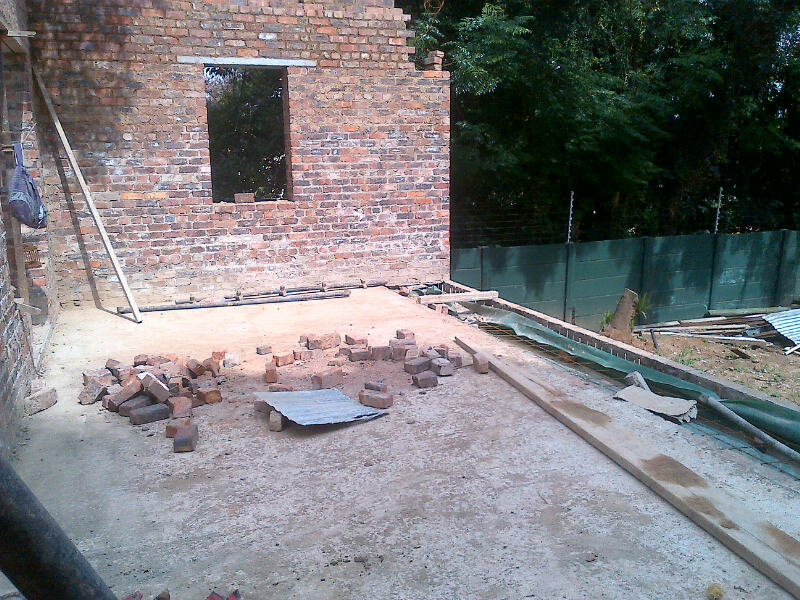
Standing on the downstairs patio, looking west.

IMG-20140121-00522

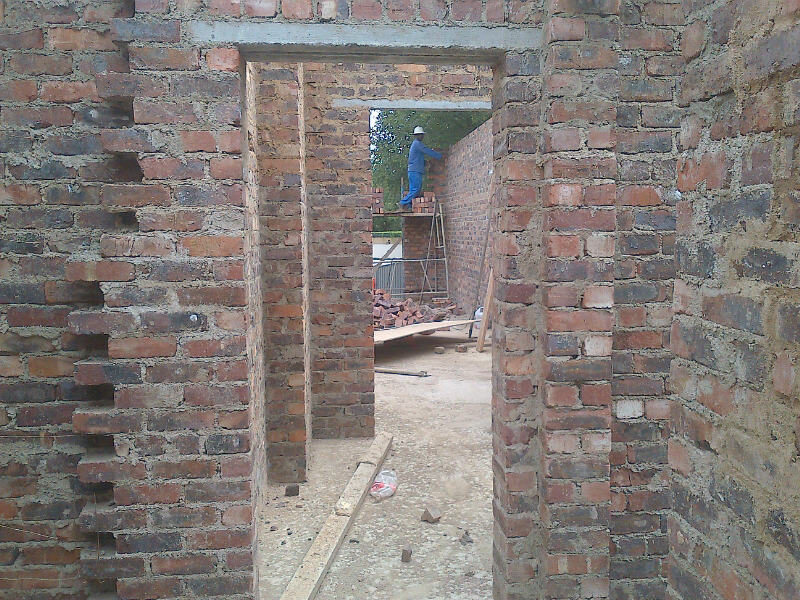
Taken from the laundry, looking through the scullery into the kitchen.

IMG-20140121-00521-1

Taken through the ‘front door’ looking north over the Treetops – which is a word that comes to mind whenever I think about the new house and which might become its name.

IMG-20140121-00526

Seven of the nine builders who were on site yesterday.

IMG-20140121-00523

Taken from the kitchen looking out through what will be an informal seating area and a bay window.

The walls are now just higher than ground-floor ceiling height and overhanging branches from the neighbours’ properties will have to be drastically cut back soon.  Watch this space…

The process of building our own home for the first time has got me thinking about what the concept of “Home” means to me and to others and how different house styles and designs may influence that concept. In my case, I think childhood literature had a huge impact on my idea of how a real home should look and how it should feel. I would be very interested to know if other people feel the same? And if anyone else out there remembers movies for the houses featured rather than for the story lines? ‘Howard’s End’ and ‘Something’s got to Give’ are two that spring immediately to mind.

I suspect it was my first ‘encounter’ with Johanna Spyri’s ‘Heidi’ that led to my love of skylights and roof windows:

Perhaps the loveliest moment of all that exciting day for Clara came when she and Heidi were in bed in the hayloft, and she found herself looking straight out to the starry sky. ‘Oh Heidi’, she cried, ‘it feels as if we were riding in a high sort of carriage right into heaven.‘”

I can still remember exactly where I was when I read that and my own bedroom seemed very conservative in comparison.

Needless to say, our new house will have several skylights.

The books in which I immersed myself as a child may also explain why I have always responded best to the traditional style houses most often found in Britain and the States. Growing up in fifties and sixties South Africa, we were bombarded with British and American literature and kept firmly away from our own.

I can admire modern, cubist, glass and steel houses for all the light and practicality they may offer: I am often awestruck by their cantilevered, engineered prowess, but I have absolutely no emotional resonance with them. I remain completely unmoved by size and grandeur and respond stubbornly only to what I perceive, completely subjectively, as charm. And when it comes to houses, charm for me translates into pitched roofs (further enhanced by attics and lofts), wood framed windows, preferably cottage-paned or sash chimneys, verandas, wind-vanes and porches. I admit to having a bit of a ‘thing’ about pitch and have just increased the slope of our new house by 5 degrees. I am suspicious of flat roofs and believe them to have a determined tendency to leak.
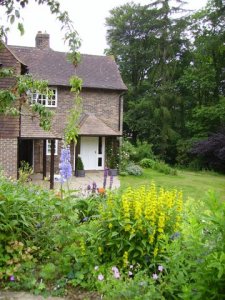
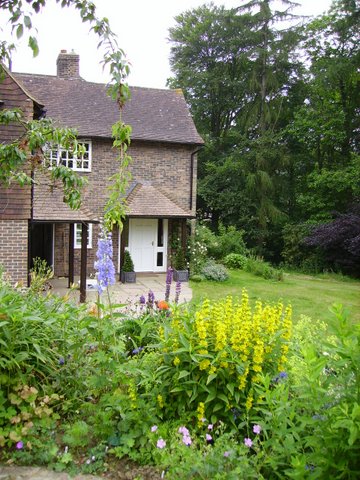
Porches and Pitched Brosely tiled roof.

Porches and Pitched Brosely tiled roof.

Straight out of childhood English literature.

Straight out of childhood English literature.

I was not born into one of these ‘English’ houses and did not grow up in one, but even as a child I would pick them out in my small South African coastal town and wonder what it would be like to live in them.

Not to say I didn’t grow up in a beautiful home. The daughter of an architect, I spent the first 11 years of my life in a lovely house designed by my father in the 1950ties to suit perfectly both the sub-tropical climate in which we lived and the property, an old quarry site, on which the house was built. In our small town, the house made a considerable statement in its day: It was the first home in East London to be built ‘back to front’ – that is, with the entertaining area and main garden facing away from the street. It was also one of the first houses to be built there with privacy in mind. Although the walls bordering the street were not particularly high, they were backed by dense shrubbery through which it was quite impossible to see. Apparently this was much discussed and the house became a destination for slow, Sunday afternoon drives.

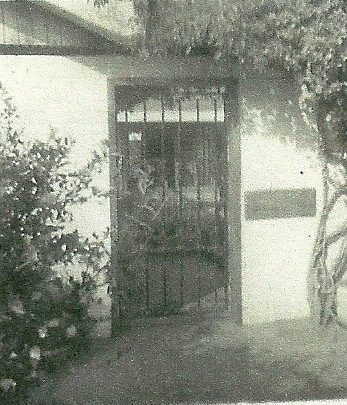
It was the first house in town to have its own swimming pool and a ‘carport’ on the street. It had a name too; ‘Many Stones’ – a nod to the quarry site on which it was built. Although in those days there was no need for locked gates and electric fences, access was through a beautiful, custom-made wrought iron gate which I remember clearly to this day.
Wrought Iron Entrance Gate to 'Many Stones.'

Wrought Iron Entrance Gate to ‘Many Stones.’
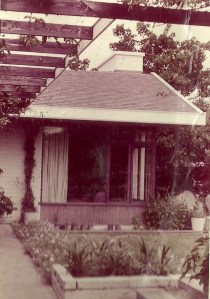
Front Path

Front Path

I remember a conversation with my father, not long before he died, in which he expressed surprise at the detail with which I recalled that home and garden. With hindsight I have also come to appreciate that my mother was a gifted gardener and the garden she created around that home, on only half an acre of multi-levelled, rocky ground was spectacular and a child’s paradise. Perhaps children experience houses and gardens more intensely than adults. A garden in not only admired, it is lived in and explored. In that garden, hideaways and secret dens were created under shrubs and in tree houses, a felled tree trunk became a crocodile, rope ladders and swings evoked the Swiss Family Robinson, while two elusive tortoises, a parrot in a courtyard, a menagerie of pets and a fish pond with stepping stones a dark, mossy grotto could keep children occupied for hours. That garden in that relatively small space offered way more interest and entertainment than acres of manicured lawn surrounded by tame flowerbeds could ever equal. My mother was ahead of herself and in another era may have been a landscape architect rather than a teacher.
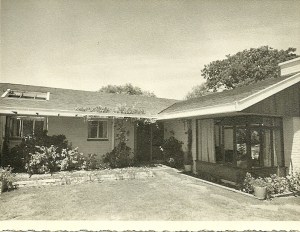
Front Garden.  Cutaway roof section to allow light into the passage.
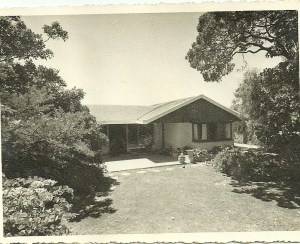
Front Garden. Cutaway roof section to allow light into the passage.

Back garden looking towards the pergola-covered patio.  Study window on the right.

Back garden looking towards the pergola-covered patio. Study window on the right.

View of the back garden with guest 'rondavel' on higher terrace.  Rockery built from on site quarry stones.

View of the back garden with guest ‘rondavel’ on higher terrace. Rockery built from on site quarry stones.

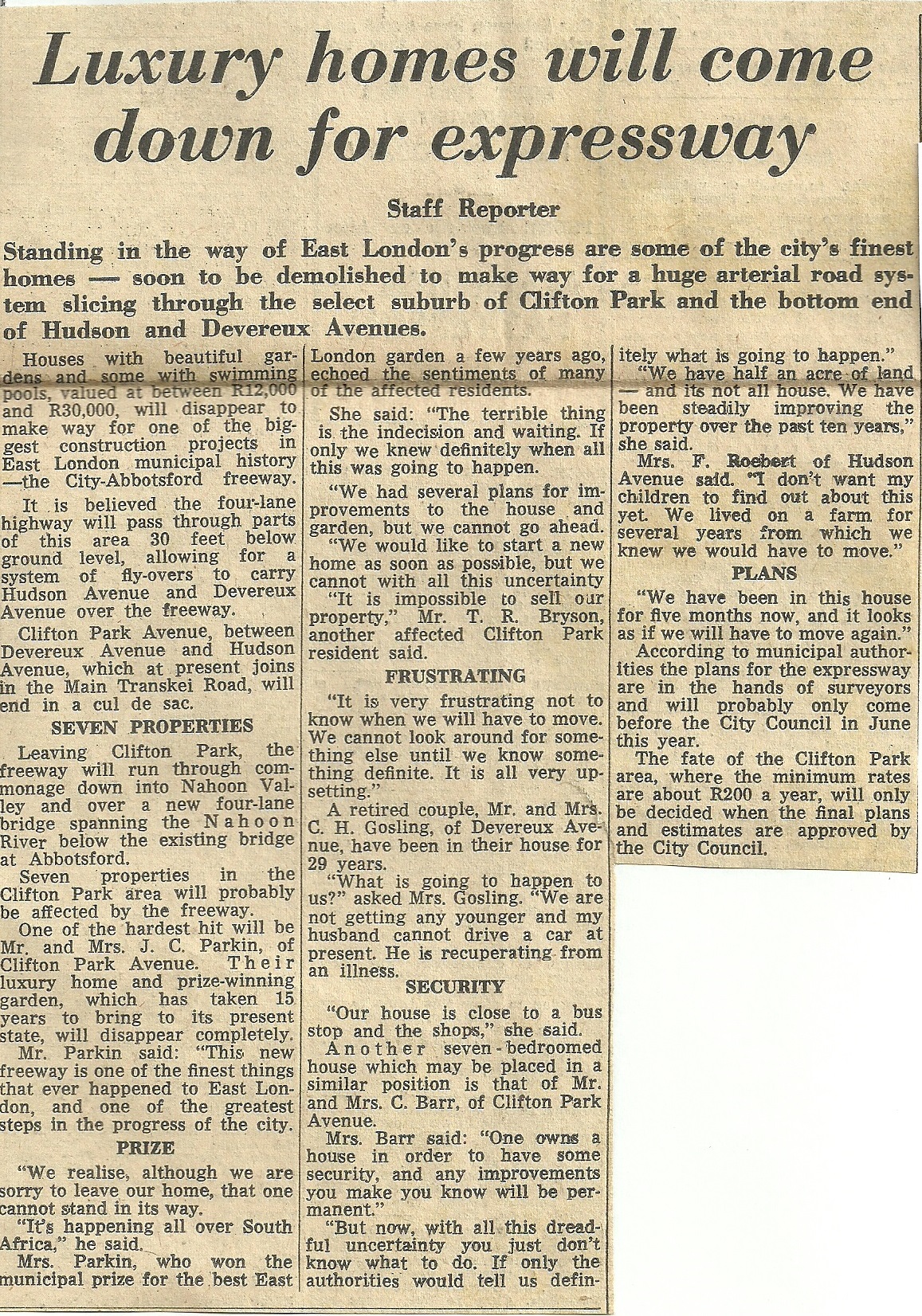
I still remember the acute sense of shock in our household on hearing that a major highway was to be built right through our neighbourhood and that our house, being directly in its path, along with 6 others, was going to have to be demolished. It must have broken my parents’ hearts and still to this day, on the rare occasion I find myself back in East London, I can’t help driving down that crudely truncated little road to the edge of the chasm through which the freeway now runs and thinking about the magical place that once existed there and the loss my family experienced through its obliteration.
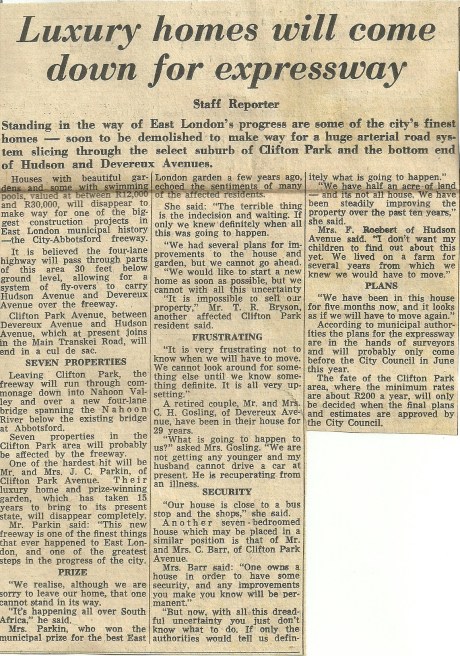
Daily Dispatch article.
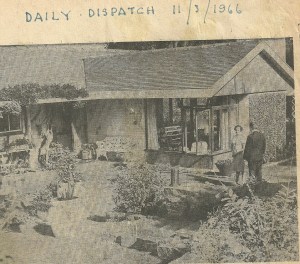
Daily Dispatch article.

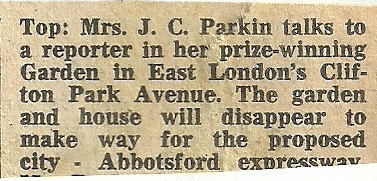
Daily Dispatch reporter interviewing my mother. The white, wrought iron bench in the centre of this photo is now in my garden.

Daily Dispatch reporter interviewing my mother. The white, wrought iron bench in the centre of this photo is now in my garden.

aDispatch Caption
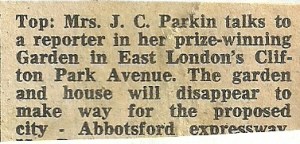
Despite these surroundings, driving around that small town as a passenger in my mother’s car, I would still pick out the more English-looking houses and I would often comment on them and ask about them. There was one I remember particularly well. It was in St James Road in Southernwood, opposite the post office we often used. I believe it is now a nursing home which makes sense. It was huge and double-storied with gables, wings and chimneys. The fact that it was dark and looked cold didn’t bother me a bit. It looked exactly like a house I’d read about in a “June and Schoolfriend Annual” and all I wanted was to see inside it. I asked about it endlessly and my mother probably wondered why. These houses might have been pretty but they often faced south – the wrong way in the Southern Hemisphere – and were completely impractical either for the climate or the typical South African lifestyle. But such was the power of childhood literature and an active imagination, I dreamt of living in a double-storey house with a steeply pitched roof of slate, shingle, Broseley tile or even thatch, and cottage-paned windows. That sort of house exuded charm for me then and to a certain extent, exudes it still. My father, influenced by Frank Lloyd Wright, would have been horrified.

Charm in a house is an elusive quality. As ‘beauty lies in the eye of the beholder’, it is different things to different people. Despite all the alterations in the world, it is difficult to imbue an intrinsically ugly house with it. I came across a quote once, attributed to Laurie Lee, that described the human quality, but it lends itself just as well to buildings.

Charm is the ultimate weapon, the supreme seduction against which there are few defences. If you’ve got it, you need almost nothing else…”

Anyone who has rounded a bend or crested a hill only to have their breath snatched away by the view of a beautiful house ahead will know exactly what this means.

Over the years I’ve become more comfortable with being South African in a changed political landscape, and though I’m still drawn to many English and American homes, I have come to love and appreciate many styles of old South African architecture just as much. The Cape Dutch architecture around Cape Town can hardly fail to appeal but more and more, it is the old farm houses I love with their wrap-around verandas, ‘tin’ roofs, creaky wooden floors and reluctant sash windows. The long drive from Johannesburg through the Karoo to Cape Town, has become so much more beguiling as a result; I wait for certain favourites to come into view. And if there is a windmill nearby, so much the better.

Well, we couldn’t find an old farmhouse into which we could ‘downsize’ in Johannesburg and most of the little houses with corrugated iron roofs that remain here are in parts of the city that are no longer comfortable. After looking long and hard for something to buy or renovate, we eventually decided that building would be our best option. My brief to the architect was just that; brief: An iron roof, wooden floors, sash windows, open plan. And then, because of the narrowness of the stand, double-storied. Bernard’s response was immediate and to the point: “A contemporary farmhouse”. That sounded like what we were looking for.
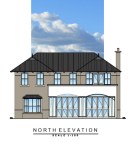
Almost up-to-date impression of the north elevation.
Almost up-to-date impression of the north elevation.

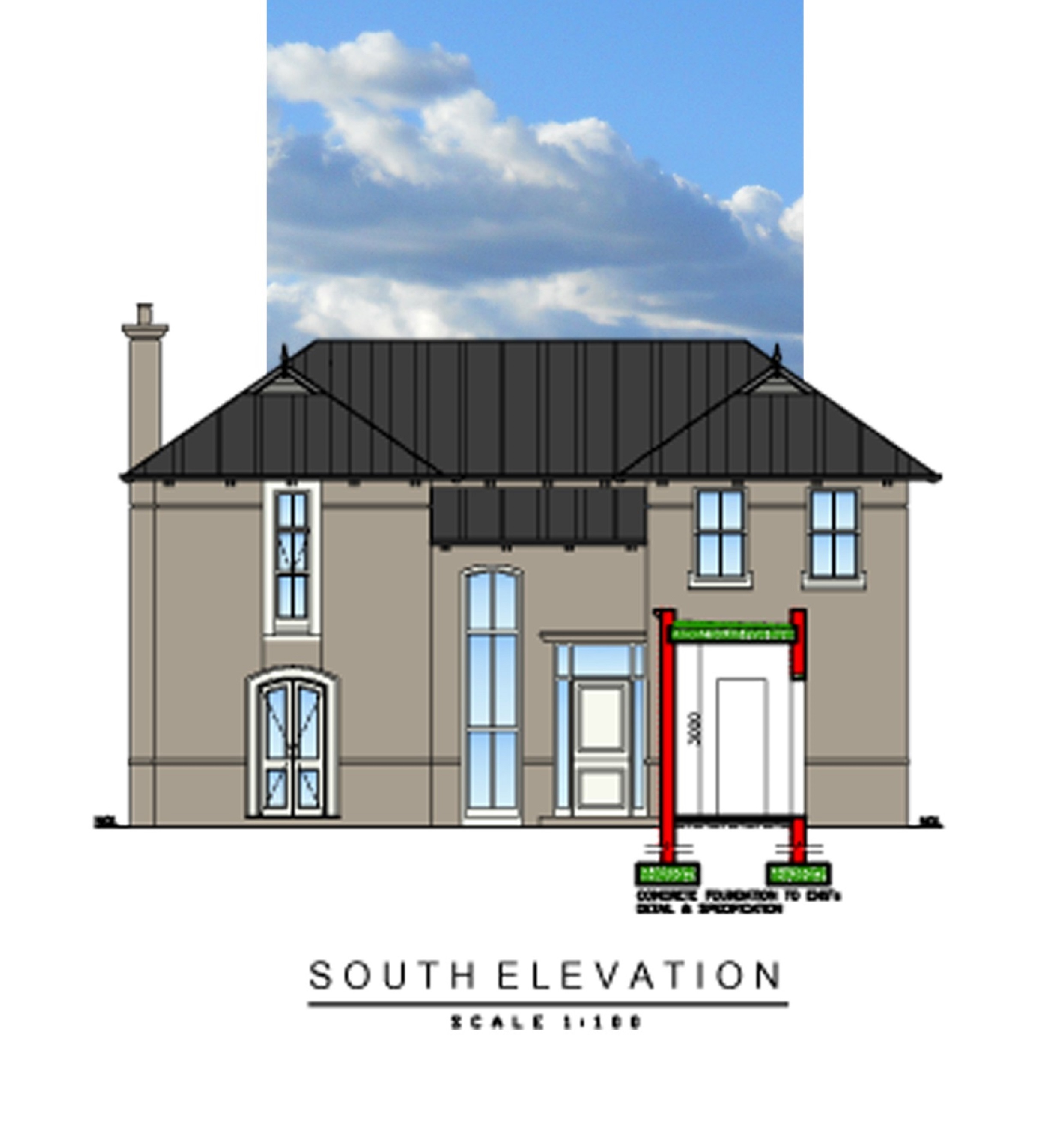
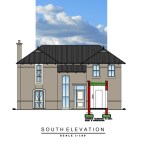
South Elevation. Some changes have been made, including increasing the roof pitch slightly.
South Elevation. Some changes have been made, including increasing the roof pitch slightly.

South African Builders’ annual holidays start tomorrow and with the persistent heavy rain we’re experiencing in Johannesburg, it’s really not a bad thing. This has been an unsettled week all round. We’ve all felt the impact of Mandela’s death and even though there have been no official holidays, there’s been a kind of ‘slowing down’ all over the country as we all pause to consider our loss.

So it feels like a good time to stop and I thought I’d pop down to the site this morning to wish the workmen Happy Christmas and Happy Holidays. I took several litres of coca cola and an enormous box of biscuits for them to have with their tea and having felt that my welcome on arrival was slightly circumspect, I left with Xmas greetings ringing in my ears. Perhaps they thought I was going to bemoan the slower-than-expected progress and ask why they couldn’t work in the holidays…

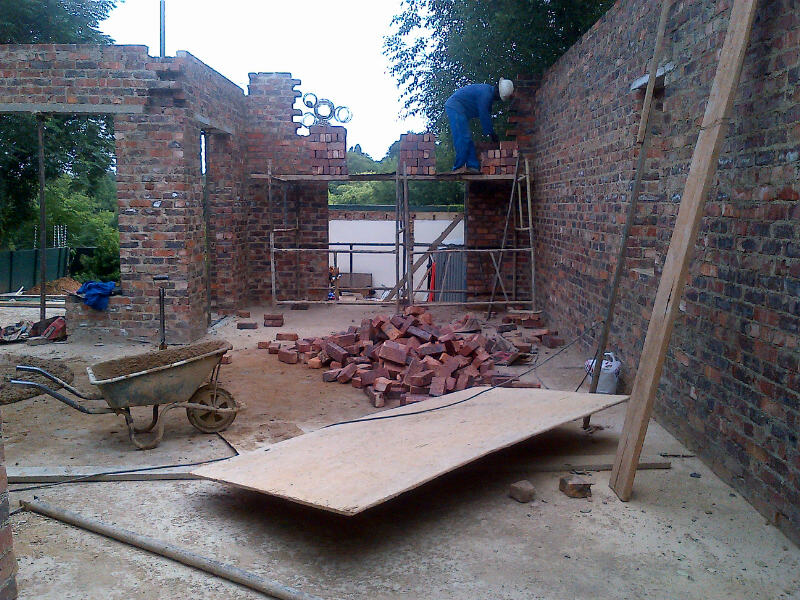
I was surprised at how much more brickwork there was since my last visit, given the uncooperative weather….

Back (south) wall of the library.

Back (south) wall of the library.
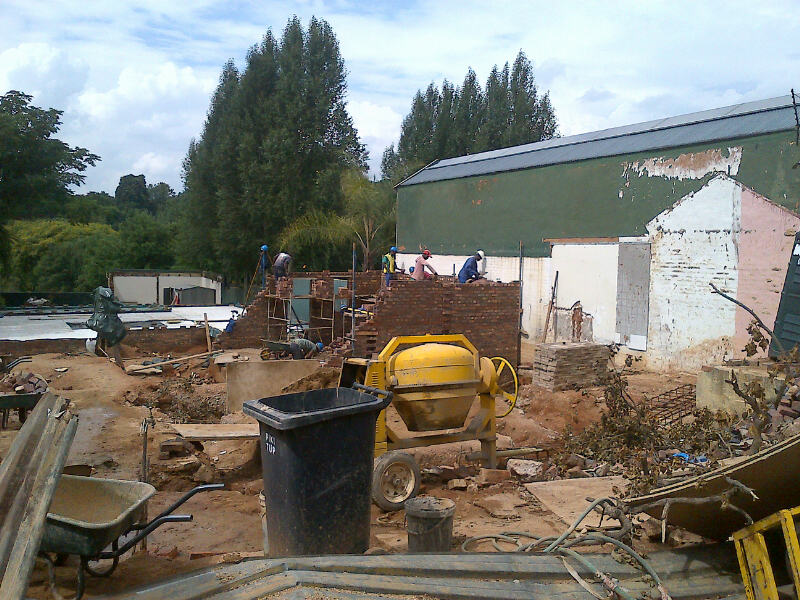
East wall of kitchen and living room going up.  The bin is standing in the entrance hall.

East wall of kitchen and living room going up. The bin is standing in the entrance hall.

And was also surprised to see that a board detailing the contractor, architect and engineer had finally gone up.

An official board at last.

An official board at last.

Hopefully mid-January will see us getting off to a positive start under sunnier skies.

It’s not often that one gets a happy surprise when building, but I have just had one:  Took a drive down to the site and there, to my amazement, were actual walls rising above the level of the ground.  The building of the garage is now well under way and I imagine Mark is hoping to get it into some sort of usable space before the Xmas break.  Really visible progress at last.

In this picture you can clearly see the door through to the laundry and the window into the kitchen yard.

In this picture you can clearly see the door through to the laundry and the window into the kitchen yard.

Above the Ground at last!

Above the Ground at last!

It’s more than a month since I last wrote and I wish I could say there was a month’s worth of visible progress to see.  Sadly, that is not the case.  When anyone asks me how the building is progressing, I have only one response; ‘slowly’.

We definitely did not anticipate how long the site preparation would take and adding that to the  ponderous process of getting permission to demolish and then getting the plans approved and passed, more than a year has passed since buying the site and we have little more to show for it than a footprint.

Exacerbating the situation is the weather:  We’re now well into the summer storms and torrential rains.  More than 83 mm of rain fell on the site during one storm alone about 2 weeks ago.  We had anticipated this problem which was why 6 months ago we had naively hoped that the roof might be on before Christmas.  That particular storm delayed the compacting of the soil that had to be done before concrete could be poured and it was days before the engineer felt that the process could begin.

But under the surface of things – literally – quite a lot has happened.  The foundations for the house and garage are finished and a lot of   attention has been paid to waterproofing.  Our consulting engineer is proving to be a stickler for detail and although it can seem frustrating at times, I know in the end I’ll be grateful for the attention to detail he’s shown so far.  With so much excavating and backfilling we need to have confidence in our damp-proofing.

The electricians have been on site to make provision for conduits that will run under the concrete slab of the ground floor so we have had to give careful thought to the position of wall plugs in the downstairs area.

We also had a very welcome visit from our ‘Off Shore Consultant’; an engineer who now lives in Australia.  It was lovely to take someone onto the site who not only just ‘got’ exactly what we’re trying to achieve, but who also asked lots of searching questions, made practical suggestions and with whom we compiled a list of little things to check with Bernard.  Thank you Fred!  You’ll have to visit again when there is a house to see.

Fred; Friend and "Off Shore Consultant!"

Fred; Friend and “Off Shore Consultant!”

The site itself still looks chaotic to me and this is something I find irritating.  It is an awkward site in that it is long, narrow and on a slope.  There is very little storage space for building materials but I can’t help feeling that if they could get further ahead with the driveway and garage, they would create an easy and practical area for piles of sand and stacks of bricks.

There have been a few minor grumbles from ‘neighbour on the left’:  A truck clipped a piece of her electric fence and she objected -with reason – to building sand being dumped in the road.  We’ve managed to sort these issues out without drama.  Every complaint comes with a tagline threat of legal action. It’s not a line of approach to which we’re accustomed….

A few weeks ago I started to feel a little discouraged with the painfully slow process but following a good meeting with Bernard on Friday, my enthusiasm has been renewed and I’m sure that in the New Year we will start to get onto more interesting things.  Builders, contractors and all related services take a month-long break in this country, from mid-December to mid-January, and like many other professions, there is a strong sense of winding down from as early as the end of November.  So we’re putting the building process on a back burner for now and instead giving some thought to other aspects like bathroom and kitchen layout and finishes.

IMG-20131129-00410

Checking details

Checking details

At this stage, Mark – the contractor – hopes to get the concrete poured throughout the ground floor of the house and garage and the screeding done.  We have a new foreman on site now.  The original one fell out of a tree.  Fortunately that did not happen on our site.  He is recovering but it seems he will be put on another project once he returns to work.  Now we have Rupert and so far I have felt that he pays close attention to details raised at the site meetings and follows up on them.  He hopes to still be able to make a start on the brickwork of the garage over the next two weeks.  But we’re not holding our breath.


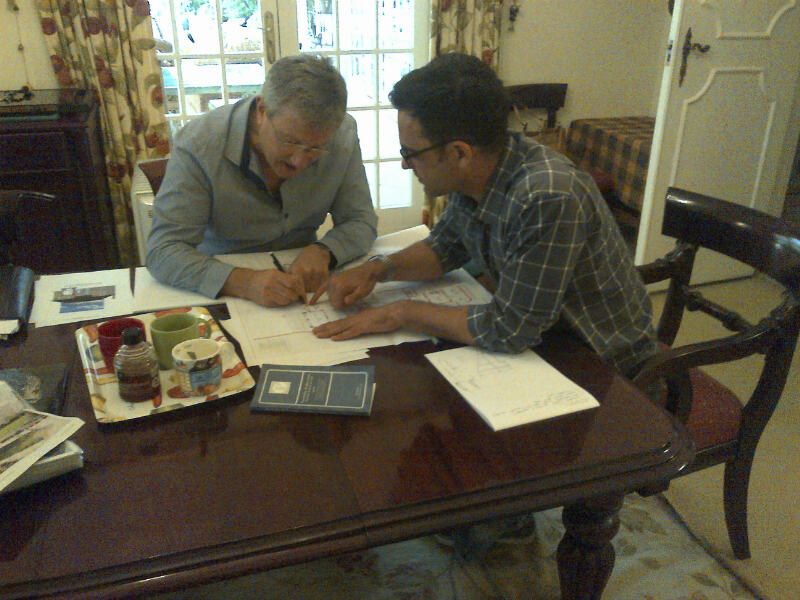
We had another site meeting today and it was not straightforward.  The ground floor level was several brick courses higher than originally planned and definitely higher than we were happy with.  We really want to avoid having a very tall house looming over a narrow stand.    We could never have anticipated that something as prosaic as a sewer would complicate our plans in this way.  After much – quite heated – discussion about various options, including storage tanks and pumps (strongly vetoed by me), moving the guest toilet to the landing level on the stairs (possibly tolerated by me but not happily), we arrived at a compromise that looks like a possibility:  With a slight alteration to the existing guest toilet area, we should be able to include two steps which will give the troublesome loo the necessary height.  We should still, hopefully, get away with having only two steps up to the front door and two steps from the patio down to the lawn.  Whoever would have thought that the smallest room in the house could give the most trouble?

So it was back to the drawing board for Bernard this afternoon and yet another meeting planned with the engineer to confirm, once and for all, that this plan will work.

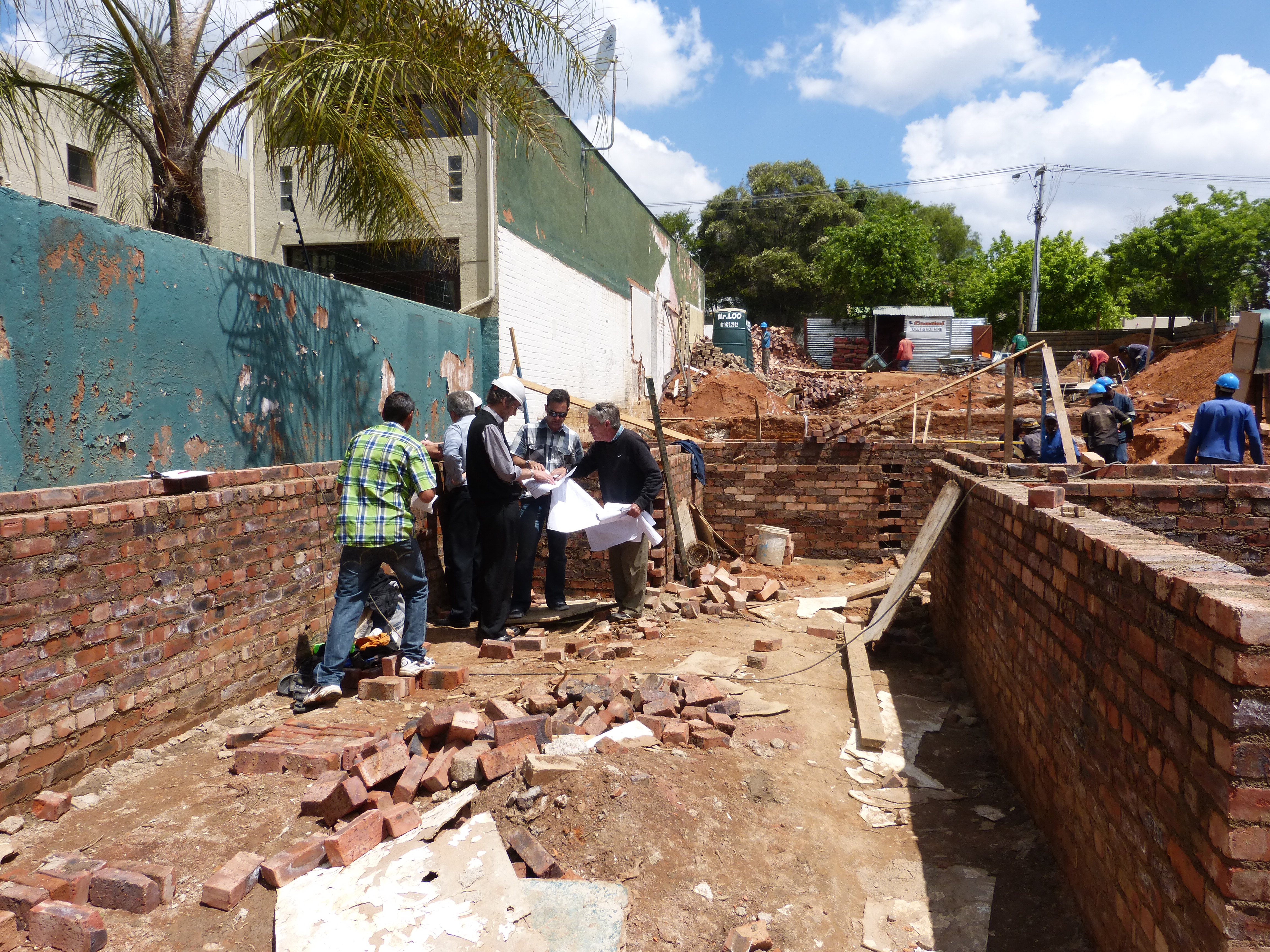
Discussion taking place where the scullery will be.

Discussion taking place where the scullery will be.


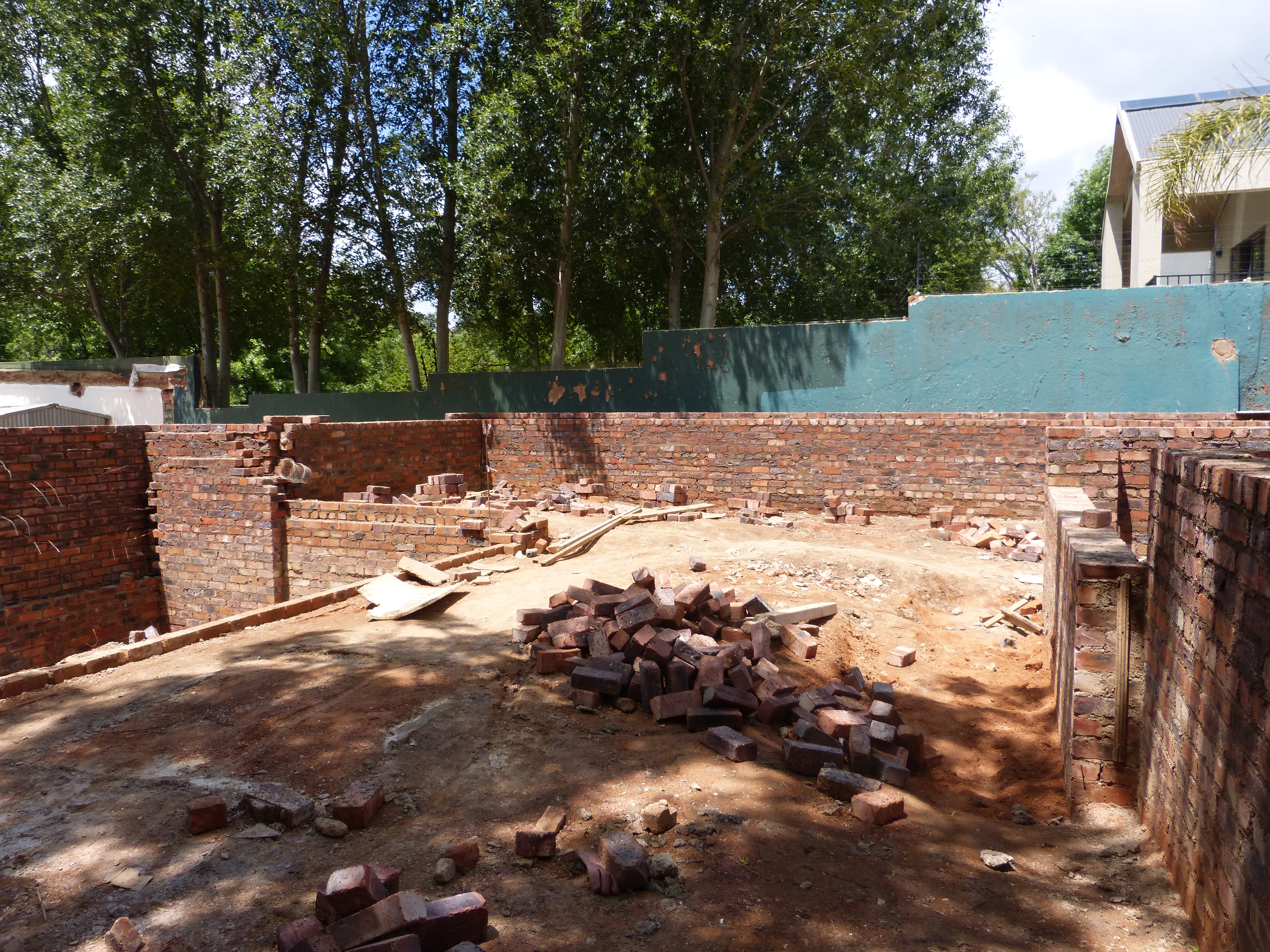
Taken from the west end of the living room.  The 'library' will be on the right and the patio on the left.

Taken from the west end of the living room. The ‘library’ will be on the right and the patio on the left.


Lunch Break!

Lunch Break!


Now that the foundations are in place, it seems like a good time to post a copy of the ground floor layout:Phurst Ground FloorplanThis is a simplified plan but for anyone who might be confused here are some pointers:

The cottage is at the bottom of the plan.  It is positioned south of the house, on the street and has the driveway on the left.

The driveway slopes downwards and turns right into the garage which is linked to the house through a door into the laundry/mudroom.

And then there is The House.

One or two people have asked ‘what sort of house’ we’re building and also, what I meant in an earlier post when I said I wanted a ‘South African house.’  To the first question I answer that we’re building a double-storey house with an iron (tin) roof, sash windows and wooden floors.  These are the criteria I gave Bernard in a nutshell.  To which he responded, rather to my surprise, that I was describing a ‘contemporary Transvaal farmhouse.’

This was something of a revelation to me as I had not before given much thought to differences in house styles in various parts of the country.  With the exception, perhaps, of the beautiful Cape Dutch architecture in the Western Cape.  So I think I’ll have to devote a future blog post to the reasons behind this choice.

Other features I mentioned were the direct link from the house to the garage, a covered patio and lots of skylights and, if possible, a sunny bay window.   We wanted one open-plan living area and an open plan kitchen since at this stage of our lives we have no need of either a formal dining or sitting room.  I also asked for separate bathroom facilities with outside access for casual workers as I’ve found this to be a bit of an issue in other houses.  Looking at this plan, we seem to have covered all these points.   But what Bernard (our architect) doesn’t know yet is that somewhere or other, inside, outside or on the patio, there is going to have to be a swing….  I’ll break that news to him further down the line.

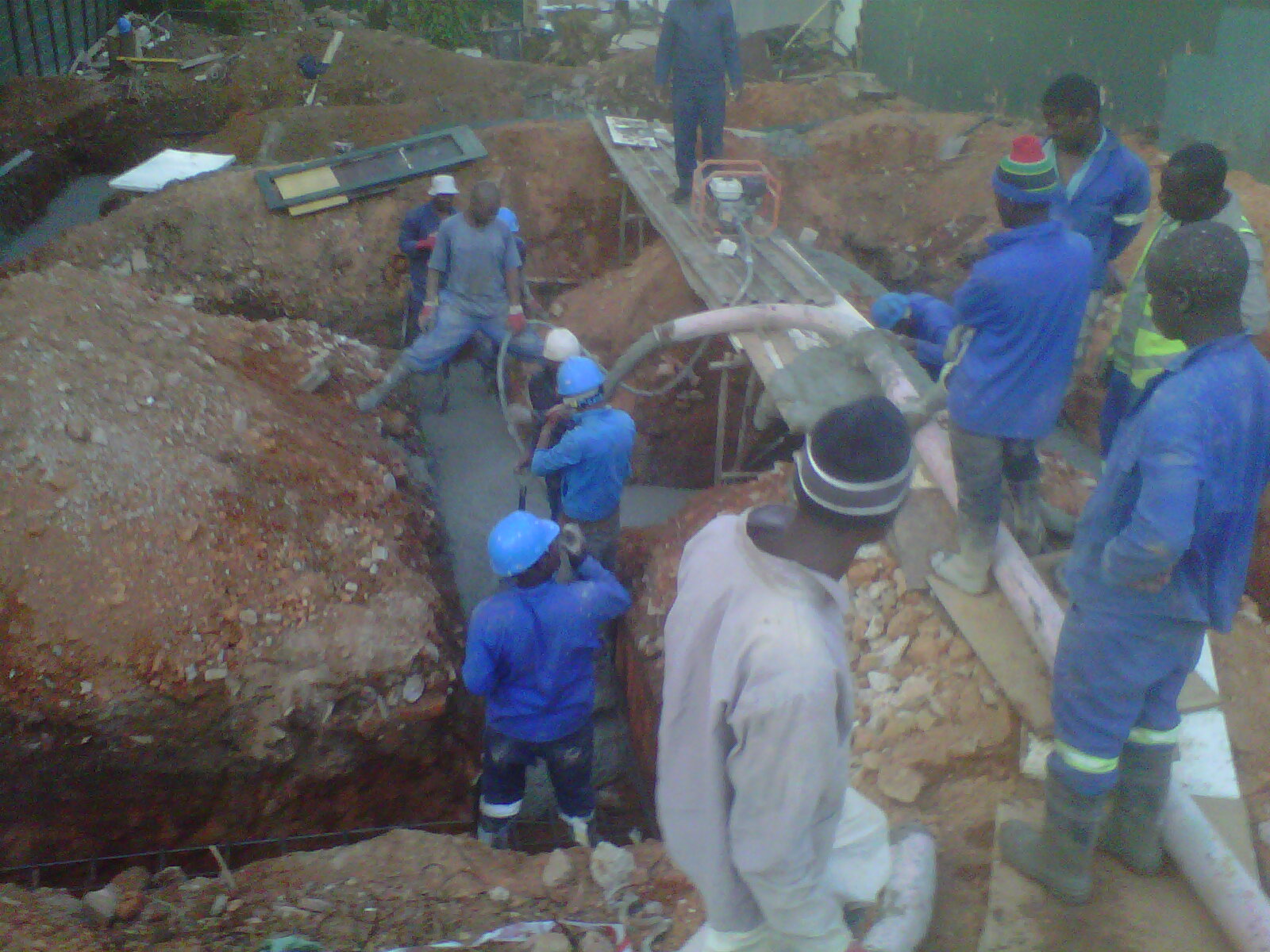
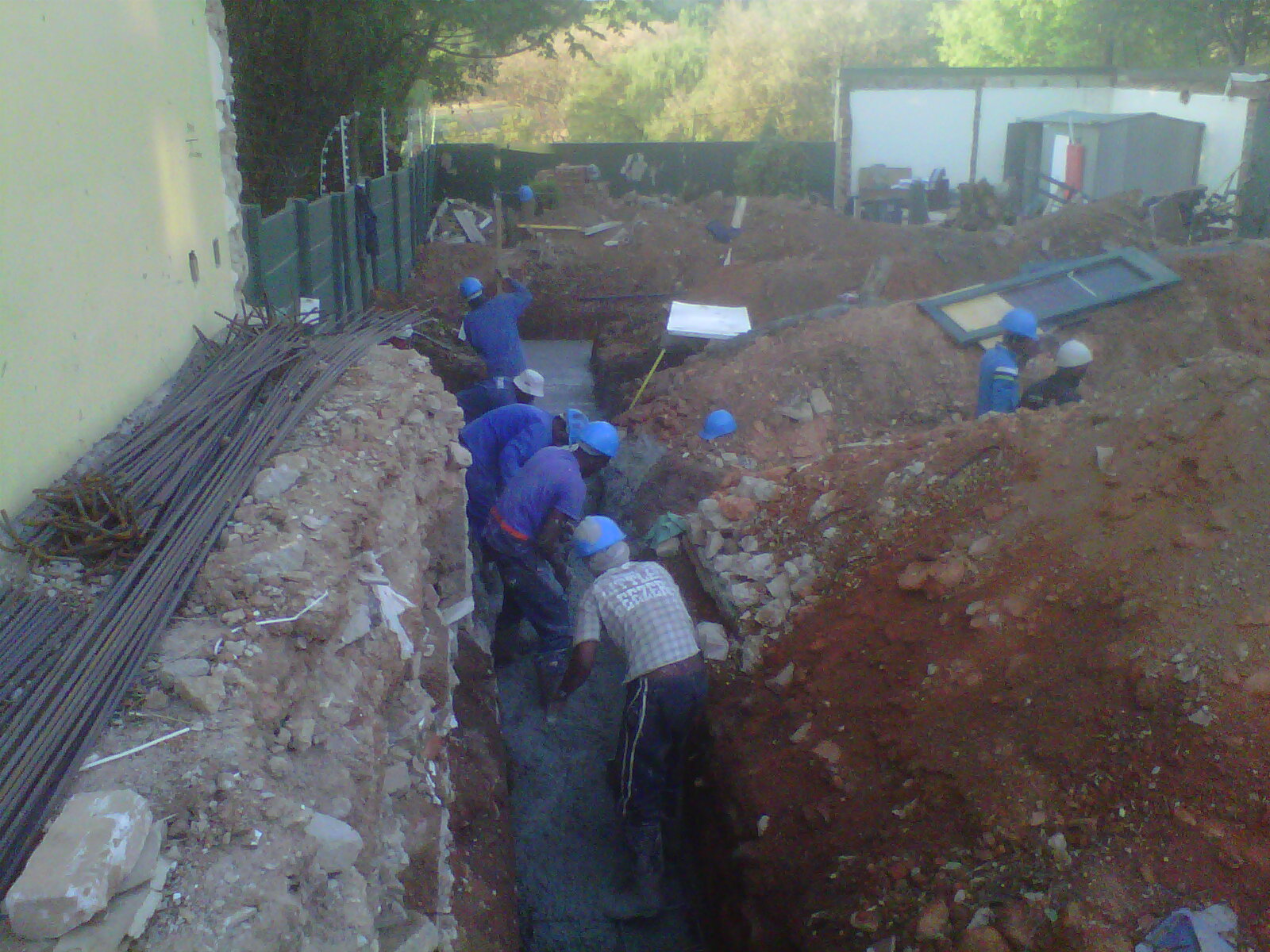
The foundations for the main house were poured on the 2nd of October.  This is what it looked like:

The Concrete Mixing trucks arrived at 5pm and caused just a little chaos.

The Concrete Mixing trucks arrived at 5pm and caused just a little chaos.

Pouring....

Pouring….

.....and smoothing.

…..and smoothing.


Finishing the pour under floodlights.

Finishing the pour under floodlights.