I have just returned from Middle Earth.  Or at least, that’s what it feels like.  I had reason to travel to the Natal Midlands this weekend and while there, being alone, I decided to take myself off on my own little Midlands Meander.  It is a beautiful part of the country which not even the very inclement weather could disguise.  Winding lanes, paddocks sheltering sleek horses or jersey cows can leave one feeling quite confused as to ones whereabouts.  I half expected to see Peter Rabbit popping through the garden gate but such notions were soon dispelled by the scampering of vervet monkeys across my cottage roof.

Road to Middle Earth

Road to Middle Earth

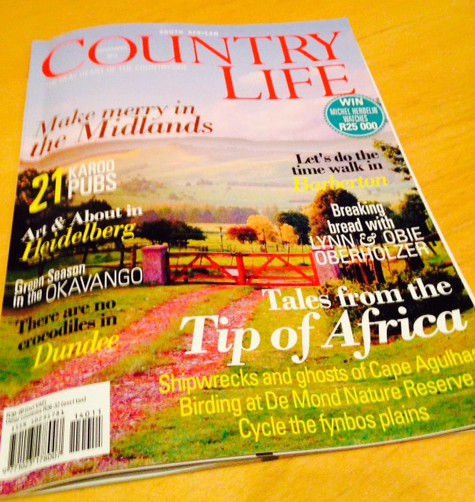
Quite fortuitously, on the way down to KwaZulu-Natal (or KZN as it’s known locally), while stopping for coffee, I’d bought the latest issue of South African Country Life magazine, beguiled by the heading ‘Make Merry in the Midlands’ on the cover and once I’d checked into the Old Halliwell Country Inn and thawed out slightly, I checked out the article and a paragraph dedicated to Culamoya Chimes caught my attention.

November 2014 Country Life magazine.

For some reason I have always loved Bells.  I love their shape and I love the sounds they make.  The pealing of real church bells can stop me in my tracks and waking to their call on a Sunday morning is something I’ll miss when we move from this house which is just three doors down the road from St Martins in the Veld.

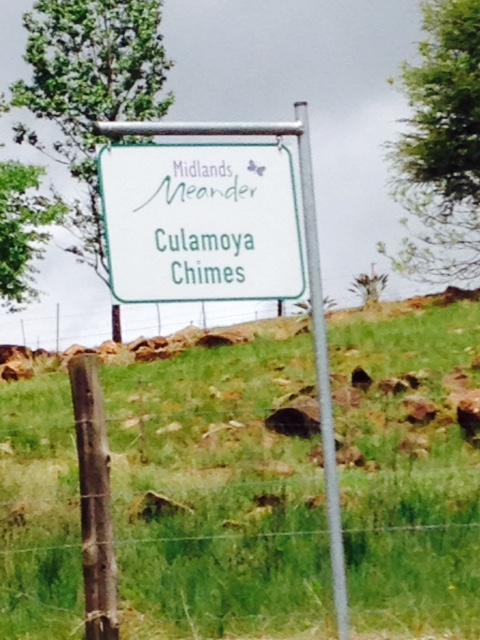
So not even winds, stormy skies and intermittent squalls of rain could stop me setting out on my own Midlands Meander on Saturday morning with Culamoya Chimes as my destination.  I have always loved having wind chimes in the garden and it just so happens that the set of musically tuned ones I’d have for years had only recently been reluctantly retired.

Culamoya Chimes Sign

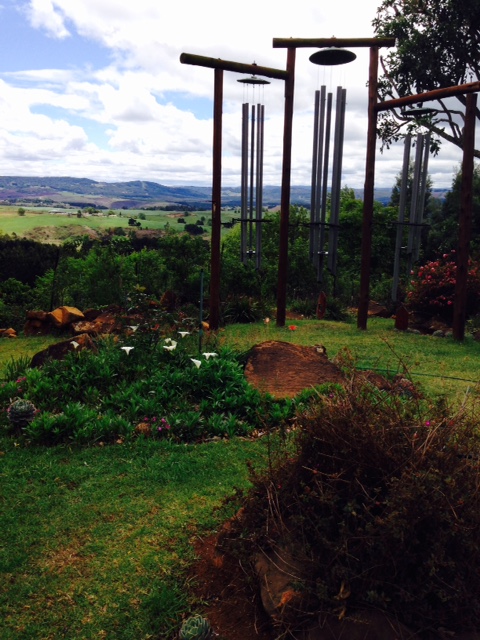
A steep, tree-covered country road led me uphill to a pretty garden and there in front of me, at the edge of the garden just before it fell away into the valley below, stood three enormous chimes ‘ the biggest hanging wind chimes in the world.’

'There Were Bells on a Hill."

‘There Were Bells on a Hill.”

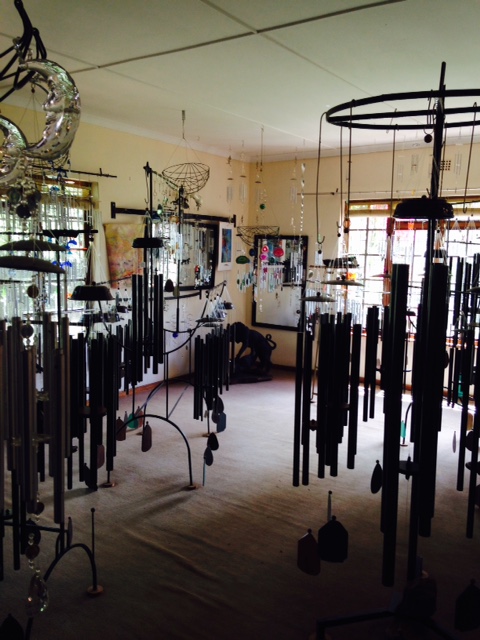
I was quite enchanted; not only with the huge chimes but also with the showroom and Frik and Lona Haupt, the makers of this vast array of musical chimes.  It was really hard to make a choice; all had names and some pealed out the notes of St Pauls or Winchester Cathedral; some had higher tones than others, some were very small and slightly ‘tinkly’ while others were deeply resonant.

One section of the showroom.

One section of the showroom.

I leant towards the deeper ones and eventually settled on one called ‘Cape’.  Frik explained that the thickness of the tubes has an impact on the resonance of the chimes and it seems that quite unconsciously I had chosen a set whose sound ‘shouldn’t carry too far’ which is probably lucky seeing they will eventually hang in a small garden in a built-up neighbourhood.  He wrapped them up very securely in bubble wrap and sent me on my way but not before he’d presented me with three beautiful long-stemmed proteas from his ‘daughter’s protea farm on the opposite hill’.  I had not realised that proteas grew in that part of the country but when he pointed, there I could see them quite clearly, marching in pink rows across the hillside.

Proteas in Jhb - all the way from Middle Earth.

Proteas in Jhb – all the way from Middle Earth.

It was a magical morning and when my Cape Chimes are eventually installed in our new little garden I will enjoy the memories they evoke.

Wind Chimes Reflected.

Wind Chimes Reflected.

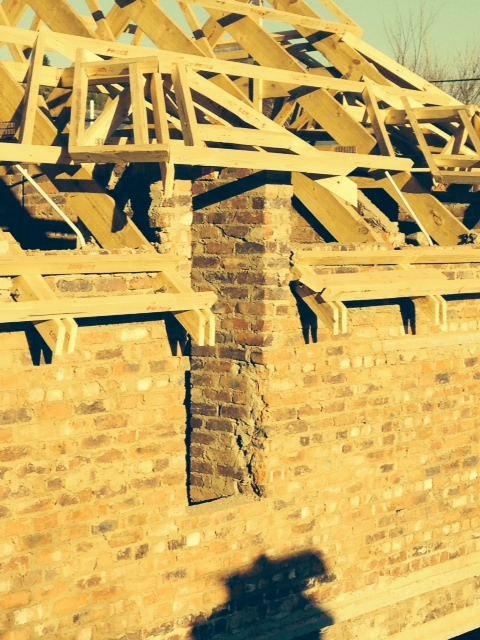
You  may have noticed that this blog has been a little quiet lately.  That’s because I’ve been busy dusting off my broomstick, donning my witch’s hat and taking flight over Parkhurst. Witch on brookstick Progress seems to have been painfully slow over the last month or so and I have taken to making regular, unscheduled site visits in an effort to keep a closer track of things.  I had been warned that the closer one gets to the finishes, the slower things seem to be but this just seems to be extreme.  We have given up all hope of moving in this year although our contractor continues to blithely assure us that he will be ready to ‘hand over’ when the South African building industry closes for the month long summer holidays in mid-December.  At this stage, I’m thinking February looks like a possibility but with each passing week I become less confident of that too. The roofing company that started off so well, disappeared after completing the house roof.  In their defence, the cottage wasn’t ready for them at the time, but when it was,  it took weeks and threats to get anyone back to continue.  Yesterday, finally, they were there putting final touches to the trusses and hopefully the sheeting will go up within the next few days.

Finishing off the cottage trusses.

Finishing off the cottage trusses.

Windows being installed in the cottage.

Windows being installed in the cottage.

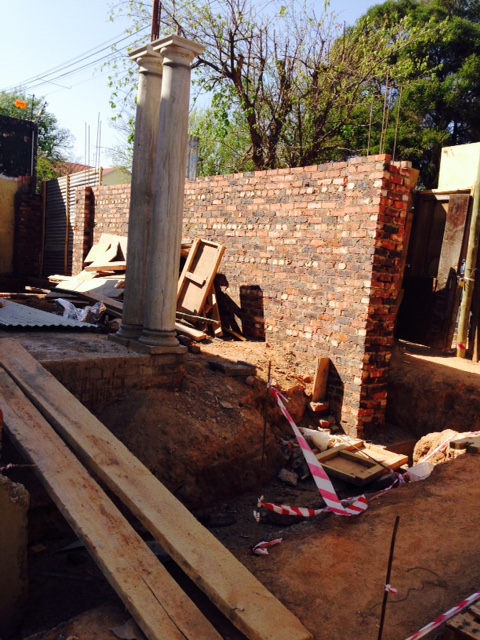
Work has also started on the street-front boundary wall –  you can see the brickwork in the photo below – and the foundations have been dug for the wall on the park side. The street wall will eventually be 2.5 metres high

View of street boundary wall from the inside.

View of street boundary wall from the inside.

Our neighbour on the left has also agreed to have the mishmash of walling between her property and ours replaced, having been adamant at the start of this project, that she wanted to keep it just the way it was forever.  So that has come as something of a relief and Bernard has completed the drawings for the new one.  We have agreed with her that the wall will be built in stages, so allowing her to move her dogs from one section of her property to another without the risk of them escaping.  She is also very concerned about security and we need to be sure that the park boundary is pretty much impenetrable before we start on the shared one.  So this part of the build calls for careful project management and diplomacy… Having all this time to play with leads to new ideas and changes which can be good but which probably also give Bernard and Mark sleepless nights.  One such change is going to happen in the upstairs pyjama lounge.  In this house, the pyjama lounge is essentially an extended ‘landing’ at the top of the stairs, between the main bedroom on the left and the two smaller bedrooms on the right.  We started off with two windows facing north over the park but over the last few months, when visiting the house, I have found it visually irritating to arrive at the top of the stairs and being confronted with the panel of blank wall between the windows, rather than having an almost uninterrupted vista over the treetops.

The view that currently greets one at the top of the stairs.

The view that currently greets one at the top of the stairs.

This is the outlook from the main bedroom.  I'd like the pyjama lounge to have a similar view.

This is the outlook from the main bedroom. I’d like the pyjama lounge to have a similar view.

Finally, when showing Australian relatives around the house 10 days ago and realising they felt the same way, I decided it was worth instigating a change.  Of course, while the window frames have been delivered in fits and starts over the past few weeks, it so happened that those two had arrived and were already in place although not cemented in yet.  I warned Nigel, the site manager, to leave them that way and started looking at other options.

PJ Lounge window frames in place - but not for long.

PJ Lounge window frames in place – but not for long.

We haven’t made many changes to the original plans and strangely, those we have made have all involved windows.  We added one to the main bedroom, removed one from the third bedroom and add a skylight in its place, removed one from the main bathroom and replaced it with a skylight and changed skylights in the cottage and guest suite into dormer windows.  I don’t think I’ll regret any of these and most of all, I don’t think I’ll regret adding more glass to the pyjama lounge. We’ve decided to replace the two windows with French doors, matching those opening onto the patio beneath.  The doors will have narrow sash windows on either side.  I was promised that the opening would be created yesterday so that I could at least see the effect.  I popped in at the site this morning to find that had not happened despite a low-flying broomstick episode over the house earlier in the week.  So I’ll be taking to the skies again on Monday.

I’ve always wanted to visit Seattle and after seeing this fascinating post, I now know why. My bucket list seems to be getting longer and longer…

D'Arcy H's avatarOur Bungalow's 2nd Century

If Eric and I have a hard time finishing our projects, maybe it’s because I keep finding other things to do. Like when I read about the Seattle Floating Home Tour, I had to buy tickets. I’ve always been fascinated by living on the water—not just at the water’s edge, but ON IT. What are floating homes? You remember Sleepless in Seattle? Well, here’s the actual house where it was filmed.

Sleepless in Seattle house

About a century ago Seattle had thousands of “houseboats,” which were cheap shacks built on floats. The city tried to get rid of them, and it wasn’t until the owners organized in the 70s to save their communities that the houses gained respect. Now there are about 500, and believe me, they are shacks no longer. Gone are the days when, as Eric says, if you couldn’t afford an apartment, you rented a houseboat. The Sleepless in Seattle house…

View original post 814 more words

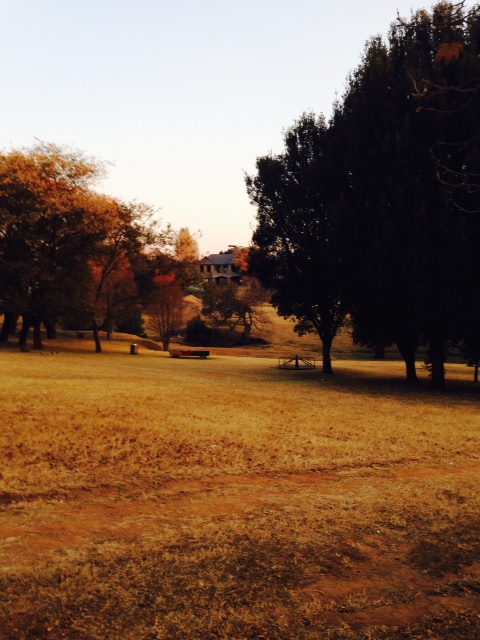
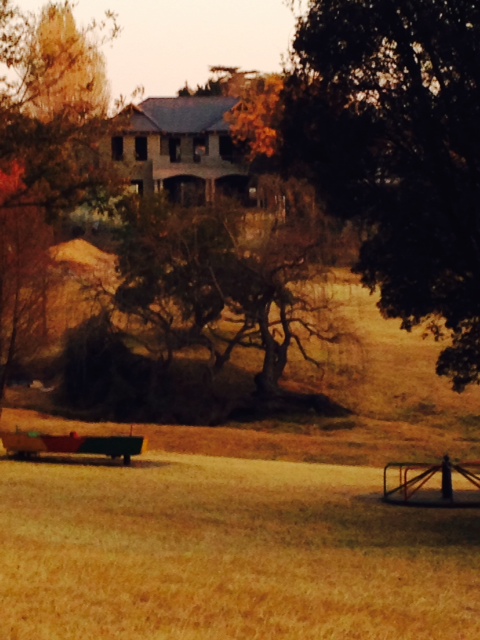
Late on Saturday afternoon we took Daisy, our hyperactive spaniel, for a walk in ‘our’ park.  It had been a beautiful, mellow, late winter’s day and the low sun cast a lambent light over the trees.  Because we always approach our house from the southern side, we tend to see it from very close-up.  It was lovely to see it from a distance, emerging through the trees.  With the roof almost finished, it’s finally starting to look like a proper house…

The park on a late winter afternoon. Far in the distance you can just make out our new house.

The park on a late winter afternoon. Far in the distance you can just make out our new house.

House emerging through winter trees.

House emerging through winter trees.

Most of the plastering, both inside and out, is now finished and the roof is almost complete.  The metal workers’ strike has caused a slight delay in the delivery of some of the sheeting needed for the roof over the front door and porch area and also, for the cottage.  We’re hoping to get both those areas done within the next week.

Some of the skylights have been installed upstairs too so that is a little more progress.   It’s still a long way off being finished though and I’m beginning to think it’s unlikely we’ll be able to move before Xmas.

Winter Walk in Park

This post is specially for ‘Happy Laughs’, ‘House by the Water’ and the other overseas bloggers whose projects I follow and who are following mine.

Reading about all the wonderful house builds and renovations taking place in Australia and the States, I’ve become aware of the different vocabularies we use sometimes and thought it might be fun to start a building ‘glossary’.

For my part, I have learned a few things from House by the Water.  Early on, I became a little confused by the emphasis Jo was placing on her kitchen benches.  In South Africa we use the word ‘bench’ to describe something we sit on.  A bench can be an elongated stool, with no backrest and no upholstery, that can seat several people at once.  It can also be a garden bench which might have a wooden slatted back rest or a wrought iron one.
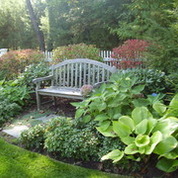
Garden bench

Garden bench

The only time ‘bench’ is used to describe a work surface is in terms of a ‘work bench’ in a wood working studio.  It is never used to describe the tops of kitchen cabinets.  We call those ‘counter tops.’  Until reading one of the earlier posts in ‘House by the Water’ I had never heard the word bench used for work surfaces in a kitchen.  Once I’d figured that out, I could easily understand why Johanne was giving the matter so much thought.

In a more recent post, I learned from ‘House by the Water’ that to have a ‘sticky beak’ was to have a look around a place, and not, as I first thought, to pop in for a casual cup of tea or coffee and something sweet and ‘sticky’ to eat….

In my post about Fountains and Fireplaces, I mentioned that we’d found an interesting fireplace manufacturer  out in the ‘veld’ and ‘House by the Water’ responded that she was off to look up the word ‘veld’.  Veld refers to open fields and uncultivated farmland.  I think in Australia you’d call it the ‘bush’.  And I suspect in the States you might say ‘the country’.  We also use the expression ‘the bush’ in South Africa but more specifically when we’re referring to an area where there are wild animals as opposed to farm ones.  Often, when planning a holiday in the Kruger National Park or  a similar game reserve, we might say we’re going to ‘the bush’.

The word ‘veld’ is an Afrikaans one, derived from Dutch which was spoken by many of the earliest European settlers in this country.

I was finally prompted to write this when I had a question from ‘Happy Laughs’ in Texas earlier this week asking what a ‘scullery’ is and for the first time I realised that I had never heard the word in the States and I’d never actually seen a scullery there either.  So perhaps it is a word and concept that hails from Britain.  To be absolutely certain, I looked it up in my trusty Oxford English Dictionary and this is what it says:

A scullery is a small kitchen or room at the back of a house used for washing dishes and other dirty household work.

It’s origin is late Middle English (denoting the department of a household concerned with kitchen utensils): from Old French esculerie.

So it’s a dishwashing space, separate  from the laundry which is specifically for washing clothes and household linens.

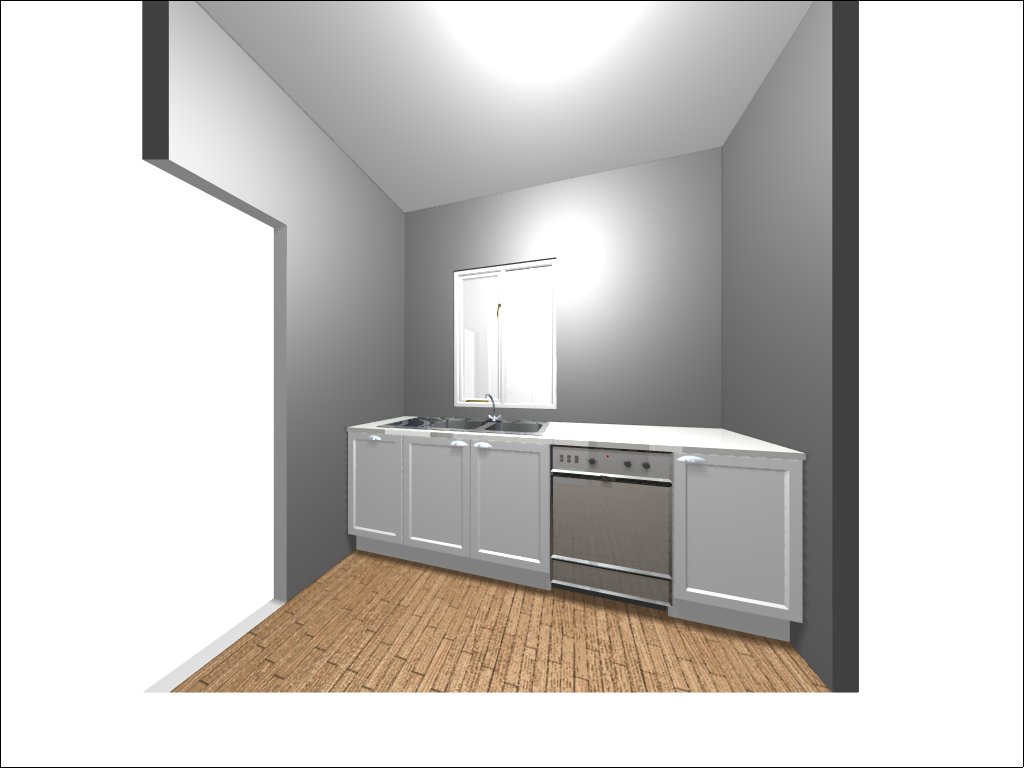
In our new home there will be a ceramic ‘butler’s sink’ in the main part of the kitchen.  I will be able to fill the kettle from there and also, if I wish, wash glasses or only slightly used crockery.  In the scullery, which will be separated from the main kitchen by a door, I plan to have a far more utilitarian sort of stainless steel kitchen sink with a draining board on either side.  Here I will be able to wash or soak bigger items like pots and pans, the roasting tray, baking trays (cookie trays) etc.  The dishwasher will be to one side of the sink.  Having a scullery simply means you can get used crockery and cookware out of sight even though you might not have the time to load it into the dishwasher immediately.
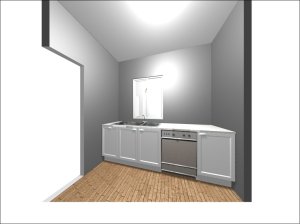
East wall perspective of scullery-to-be.

East wall perspective of scullery-to-be.

Sink is another confusing one.  In South Africa and Britain we use the word ‘sink’ only in kitchens, laundries and sculleries.  In bathrooms we use the word ‘basin’.  And on the subject of bathrooms, what Americans call the ‘powder room’ we call the ‘guest loo’ or ‘guest toilet.’  Back in the 1970ties when I was an exchange student in Alabama, someone suggested that I pre-shrink new dress fabric in the ‘lavatory’.  This led to considerable confusion and not a little embarrassment.  The word ‘lavatory’ was even then quite archaic in South Africa and had only ever been used to describe a toilet.  I had never heard it in the context of a sink or basin until then and have never heard it used in that context since.  Of course it is derived from the Latin, ‘laver’ to wash so perhaps I should have been quicker to make the connection.

Other words related to houses which have different meanings are ‘pavement’ which is what we use in place of ‘sidewalk’ and ‘yard’ and ‘hall’.

I’m not sure about Australia, but I know that in the States you might refer to your ‘yard’ as being all the property surrounding your house, including garden areas.  In South Africa a yard is very specifically the space outside your kitchen door where you might keep your refuse bins and where you’re likely to have an outside washing line. The yard is almost always paved in brick, cement or tiles.  The rest of the property is referred to as being the garden, even if there is not much in it.

In the States you use the word ‘hall’ for an area we call a ‘passage’.  The word ‘hall’ in England and South Africa refers to a large room such as one that is attached to a church for special functions.  Our schools all have ‘halls’ for morning assembly, school plays etc.  In bigger buildings like schools, we might call passages ‘corridors’ but never halls.
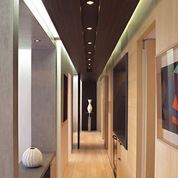
In South Africa this would only ever be described as a passage.

In South Africa this would only ever be described as a passage.

In South African homes, the ‘hall’ is very specifically the area immediately inside the front door where you might leave your coat, your car keys etc. In other words, it’s the reception area of a private house.
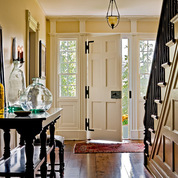
Lovely Entrance Hall found on Houzz.

Lovely Entrance Hall found on Houzz.

I know in the States it is quite usual for visitors to come in through the back or kitchen door.  This is very unusual here where we use our front doors almost all the time.  Our back doors are usually out of sight and sometimes inaccessible to visitors since they often open into walled yards.

Which brings me to ‘Mud Rooms’.  I’m not sure where I first learned about mud rooms.  It might have been in British home décor magazines and I have since come across them on all sorts of American decorating sites.  I think they are a fabulous idea and would have loved to have had one but space was something of a problem, so I’m going to have to make do with my little laundry leading into the garage instead.  They are creeping into new South African homes, I think, but they’re still a fairly new concept. This is not a country with extremes of climate; we do not often wear Wellington boots and we never need snow gear, but still, there is something awfully appealing to me about this concept.
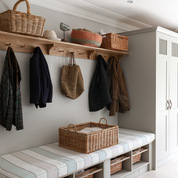
I love this Mudroom found on Houzz.

I love this Mudroom found on Houzz.

And lastly, for now, I learned something new from Houzz just a few days ago when I looked for photographs of ‘stable doors.’  Our new house is going to have a stable front door.  Needless to say, when I looked for stable doors on Houzz, that is exactly what I found, doors opening into stables housing horses…..  Somewhere along the line, the words ‘Dutch Doors’ popped up and I realised that what we call ‘stable doors’ here are called ‘Dutch Doors’ in America.
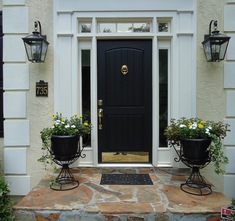
Dutch/Stable door found on Houzz.

Dutch/Stable door found on Houzz.

Given all our Dutch heritage in this country, I’m quite surprised we don’t call them Dutch doors too, but I had never heard them described that way before.  I look forward to hearing what they’re called Down Under…


Dream Kitchen

Traditional Rendering by Flemington Architects & Building Designers Pickell Architecture
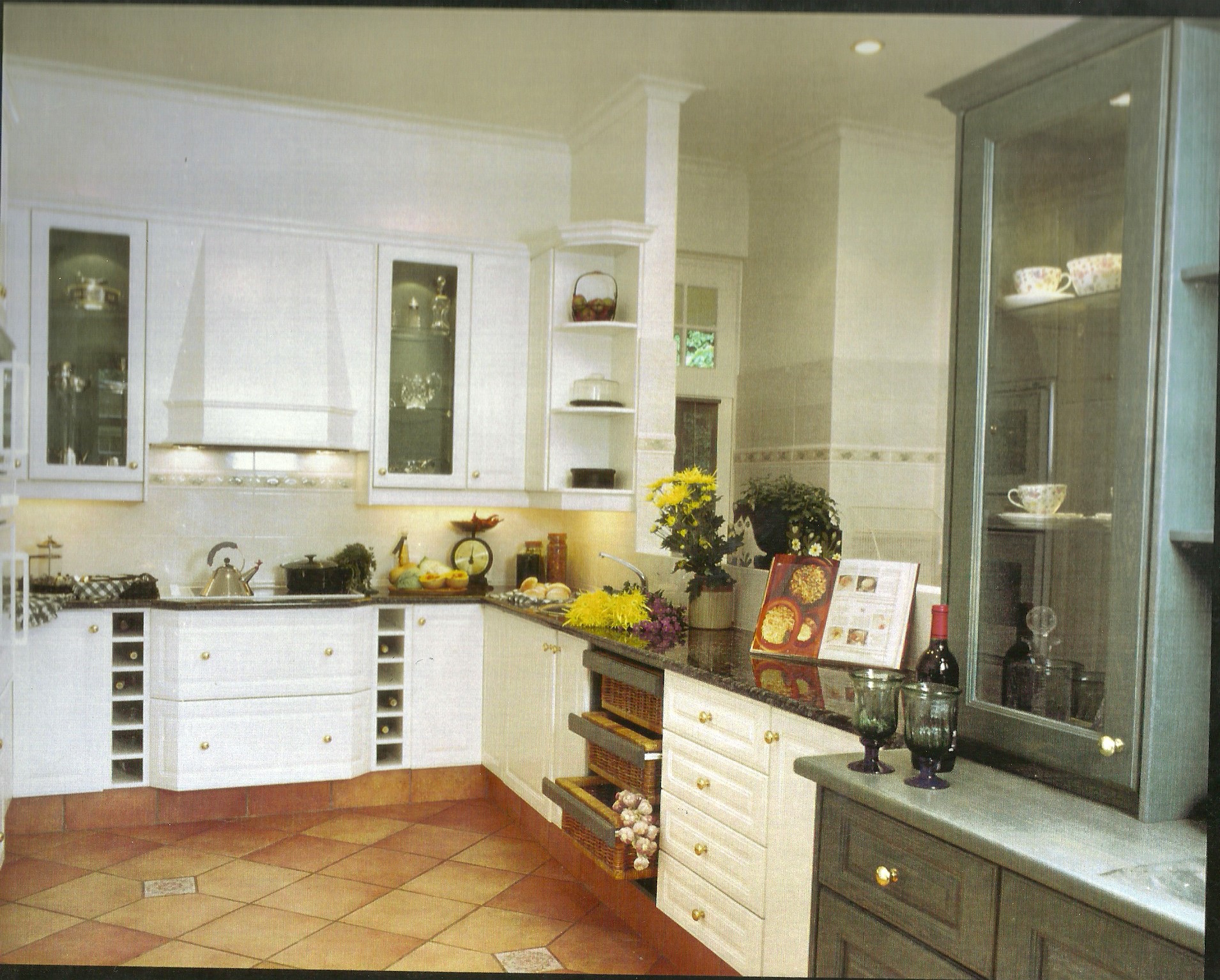
The kitchen above, found on Houzz, is one of the loveliest I’ve ever seen.  It combines three elements I have included in our new kitchen; a wooden floor, white units and a bay window.
Twenty years ago I more or less designed the kitchen below and I find it quite interesting that I am still drawn to a similar look after all this time.
Our kitchen for the past 20 years.

Our kitchen for the past 20 years.

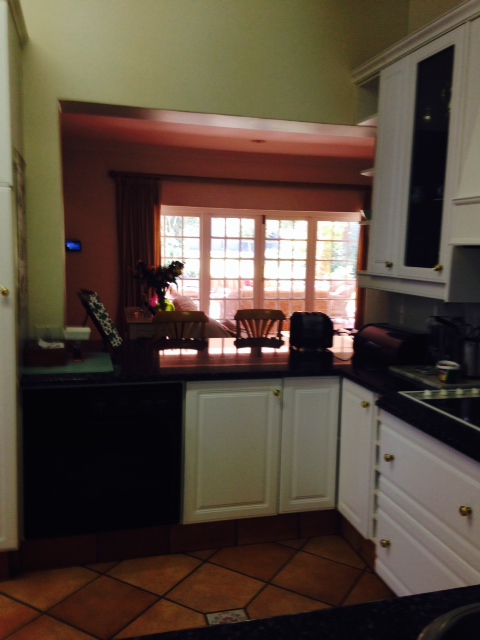
Aesthetics have always taken precedence over practicality for me (I wouldn’t have made a good Engineer…) and although I got the basic ‘triangle’ right, there would  be a few design changes I would make now, although the overall feel and appearance of the room worked for me then and still does.  I did make one change about 5 years ago and that was to knock a hole in the north-facing wall which separated the kitchen from the family room.
Hole knocked through to open kitchen up to the family room and garden.

Hole knocked through to open kitchen up to the family room and garden.

Fortunately we were able to match the granite top and could construct a new, wide countertop. It destroyed the symmetry which had been a feature of the kitchen and  I did lose some cupboard space and had to install a much smaller oven, which has sometimes been a hindrance. But the few disadvantages have been far outweighed by the advantages of being able to be part of the family room conversations, being able to keep up with rugby matches and Wimbledon from my position in front of the hob and having a view across the patio to the end of the garden.  I’ve loved it and would never choose to go back to an entirely separate, closed-off kitchen.
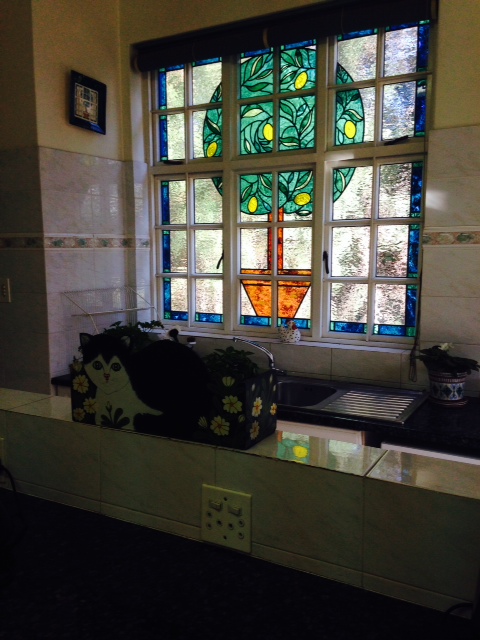
Stained Glass window in my present kitchen.  Something I'll be sad to leave behind.

Stained Glass window in my present kitchen. Something I’ll be sad to leave behind.

There are two aspects of my present kitchen that I wanted to change in the new one.  The first was to have a completely separate scullery section which is a help when you have one open-plan living space, and the second was to have direct access from the garage into the kitchen and we’ve managed to achieve this.  A door leads from the garage into a small laundry area which in turn leads into the scullery.  Good for stormy Highveld summers and for carrying in the groceries.
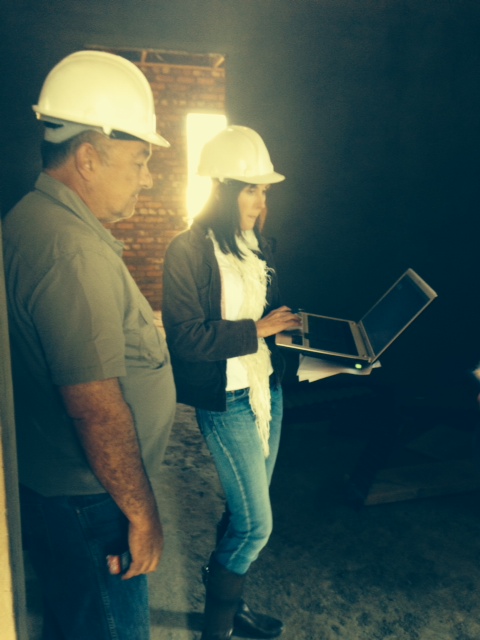
So, for quite a few months now, behind the scenes of the house-build, I’ve been discussing the kitchen design with Adri from Acube Designs who came highly recommended by Bernard, our architect.  Fortunately I took an instant liking to Adri and when I met Caspar, of Woodpecker  Creations, I took an instant liking to him too.  It makes everything a whole lot easier.
Adri and Caspar confirming measurements.

Adri and Caspar confirming measurements.

Although I had a pretty good idea of the sort of look I wanted to achieve, I also spent a lot of time browsing through various sites on Houzz and I took some inspiration from several photographs I saw there.   Friends made various suggestions too; one being that I should consider ‘two’ kitchens, a ‘front’ open plan one where all the finished products can be set out beautifully and a ‘back’ one where all the heavy-duty work goes on. The other suggestion was that I should have two dishwashers, side by side.  While the idea of two kitchens might be appealing, I have tried to keep very conscious of the fact that the biggest motivation to build this house was to Downsize and Simplify and that also applies to the sort of entertaining I expect to do.
Our present home has a separate, formal dining room and while I really enjoyed having that dedicated space when we moved here, over the past several years I have felt the need of it less and less as our way of eating and style of hosting friends has become more and more casual.
Our present separate diningroom.

Our present dining room.

The brief we gave Bernard for the new house, was to have one comfortable open-plan living area that included the kitchen.  I intend shrinking our antique dining room table down to its smallest size and using it in the library area as a writing and jigsaw puzzle surface.
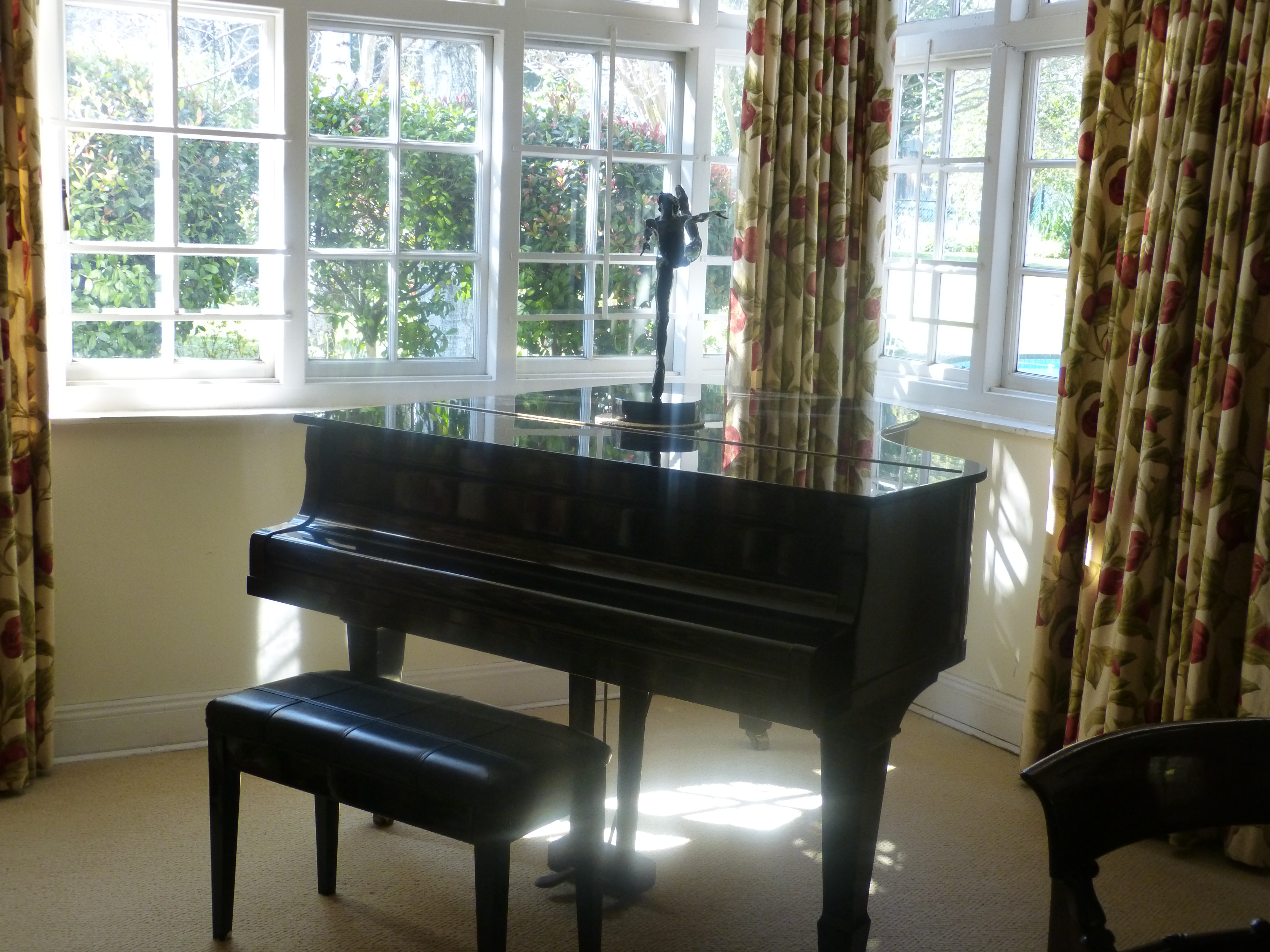
Piano in the dining room will have to go into storage.

Piano in the dining room will have to go into storage.

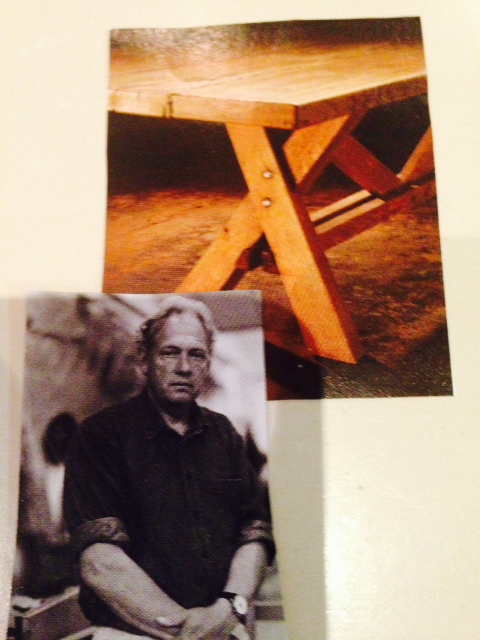
A few years ago I became aware of a South African furniture designer and manufacturer called Pierre Cronje.  A lot of his designs refer back to old Cape furniture designs and are slightly rugged without being rough.  I love his style and have chosen one of his tables to take the place of the old mahogany one.   I have been out to his Johannesburg showroom twice in the last week.  I could make a habit of it.
Pierre Cronje
So the new house will not have a dining room as such, but only a table dividing the seating area from the kitchen.  I can see it clearly in my head and I just hope it will turn out in the way I envisage it.
Beach Style Kitchen by Beverly Interior Designers & Decorators Siemasko + Verbridge
Once again, in the photo above, I like the combination of the wooden floors and white units.  We have also included bookshelves in the island in the new kitchen. 
The two photographs below, both from Houzz, got me really excited and I have asked Adri and Caspar to include two similar drawers in our new kitchen.  Although it looks like such an obvious solution for baking trays, I have never seen drawers divided vertically like this before and as baking is one of my hobbies, I am used to the chaos and cacophony of pots and pans toppling over and sometimes disappearing over the back of the drawer, while I struggle to extract the particular cookie tray or muffin pan I need which is invariably underneath everything else.
  

Below is another beautiful white kitchen and I love the light fittings over the island.  I haven’t settled on ‘island lights’ yet.  In an open plan living space I am cautious about too many hanging fittings, much as I find these really appealing.  I might start off with only down-lights – also visible in this photograph – and make up my mind about pendants when we’ve lived in the space for a while.

Something else I like about the kitchen below are the high, glass-fronted cupboards.  They are useful for taking up space between the tops of the ordinary cupboards and the ceiling and great for displaying crockery or silver that is seldom used.  I’ve borrowed this idea too.

Traditional Kitchen by Millbrook Architects & Building Designers Crisp Architects
Below are more white cabinets on wooden floors.  And more high, glass-fronted cupboards.  There will be similar handles on our cupboards.
Contemporary Kitchen by Cambridge Architects & Building Designers LDa Architecture & Interiors
And below, just for fun, is another gorgeous kitchen with a bay window.  I think I might be addicted to kitchens on Houzz.
Traditional Kitchen by Santa Cruz Media & Bloggers Shannon Malone
Close-up of the lovely bay window.  For now, I plan to put a small couch in our bay window as I think it might be more versatile, and definitely more comfortable on sunny afternoons, but I might still fall prey to the seduction of a built-in window seat.
Traditional Spaces by Santa Cruz Media & Bloggers Shannon Malone
And finally, in the modern kitchen below, I like the windows between the lower cupboards and the upper ones.  We’re going to have three, small opening windows between the lower and upper cupboards.  The boundary garden wall is very close to the windows and I’m planning to hang planters or trellises on it.
Modern Kitchen by Sag Harbor General Contractors S.M. CONTRACTING INC
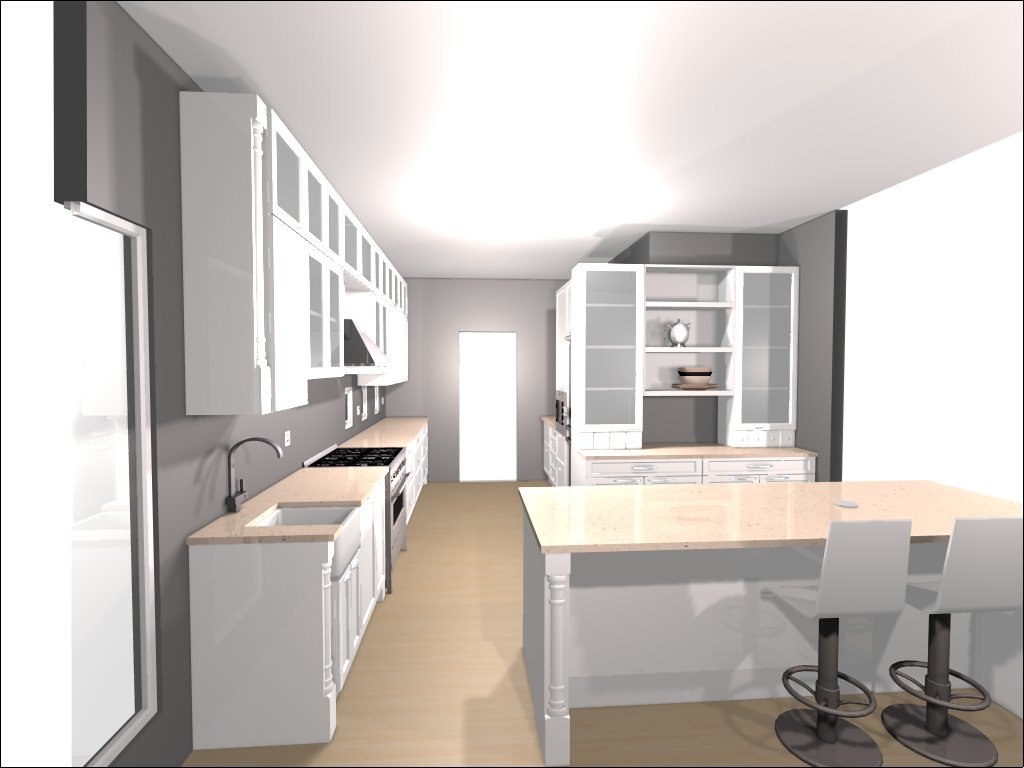
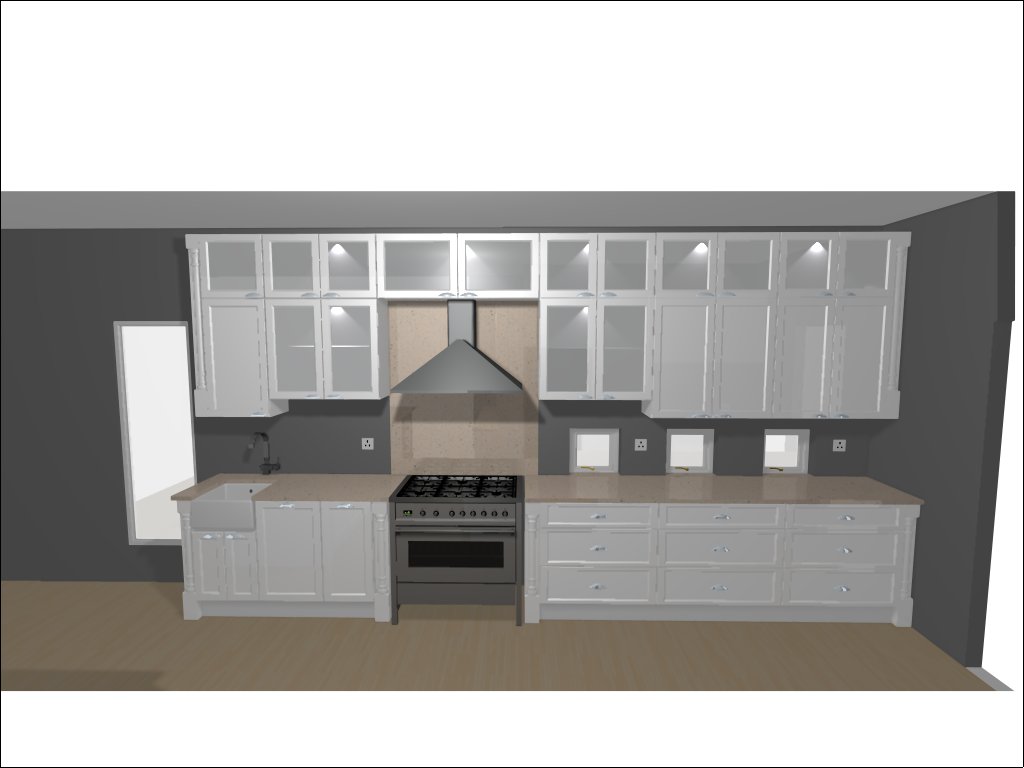
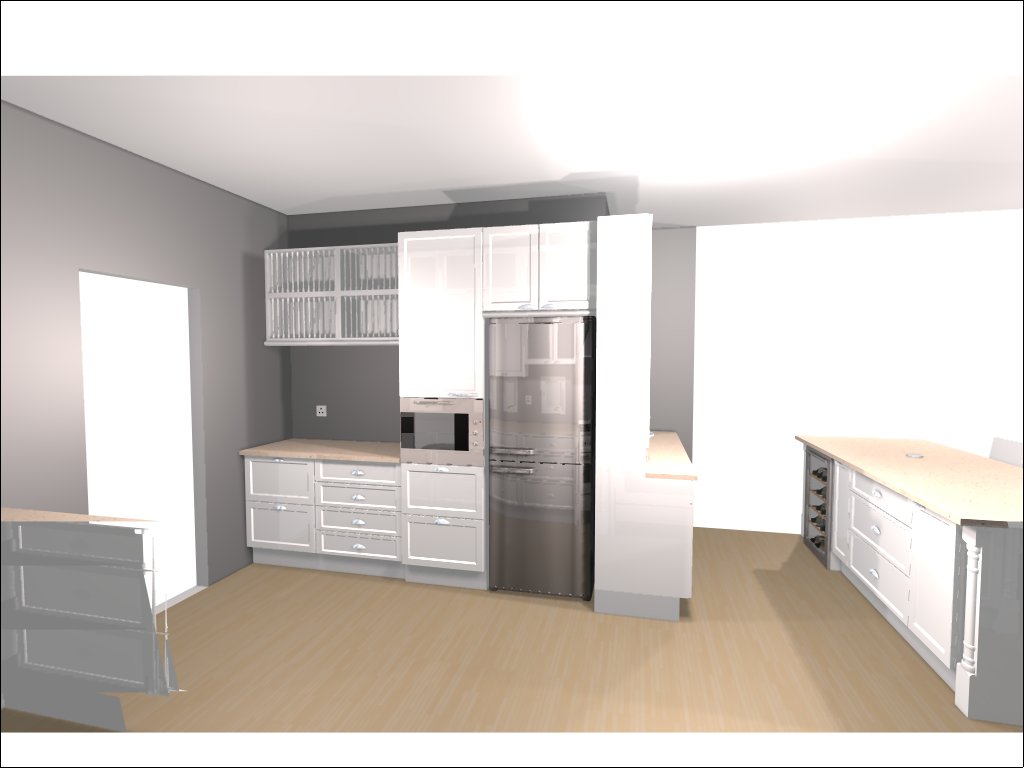
Below are three diagrams of the new kitchen.  Not all the finishing details are shown in these renderings but you can get a general idea.
Diagram of the new kitchen, from North to South.

Diagram of the new kitchen, from North to South.

In the picture above, you can see the door leading to the scullery.

East wall of the kitchen.

East wall of the kitchen.

In the drawing above, you can see the long, narrow window on the left and the 3 small windows between the lower and upper cupboards.  The long window is in line with the kitchen island from the north/south diagram.

Kitchen East Wall

Kitchen East Wall

The cupboards have ‘Shaker panel’ doors with cup handles and will be Ivory White in colour.  Now we can only wait and see.


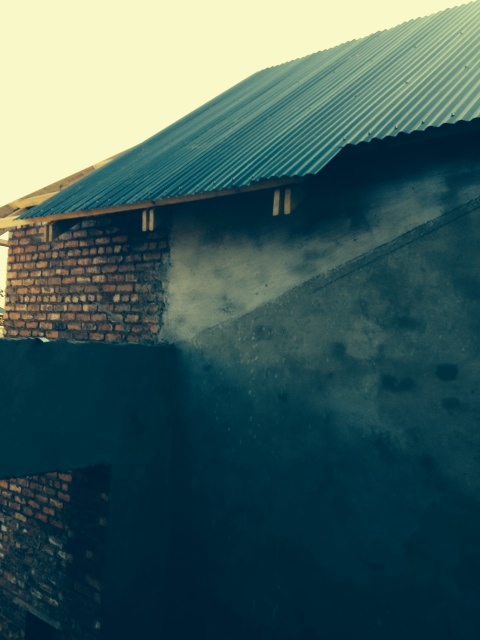
The roof sheeting is finally going on!


Iron Roof Going On!

Iron Roof Going On!

The double sprockets, which you can see under the eaves above and in the photograph below, were Bernard’s suggestion and I think they look great.

Double Sprockets

Double Sprockets

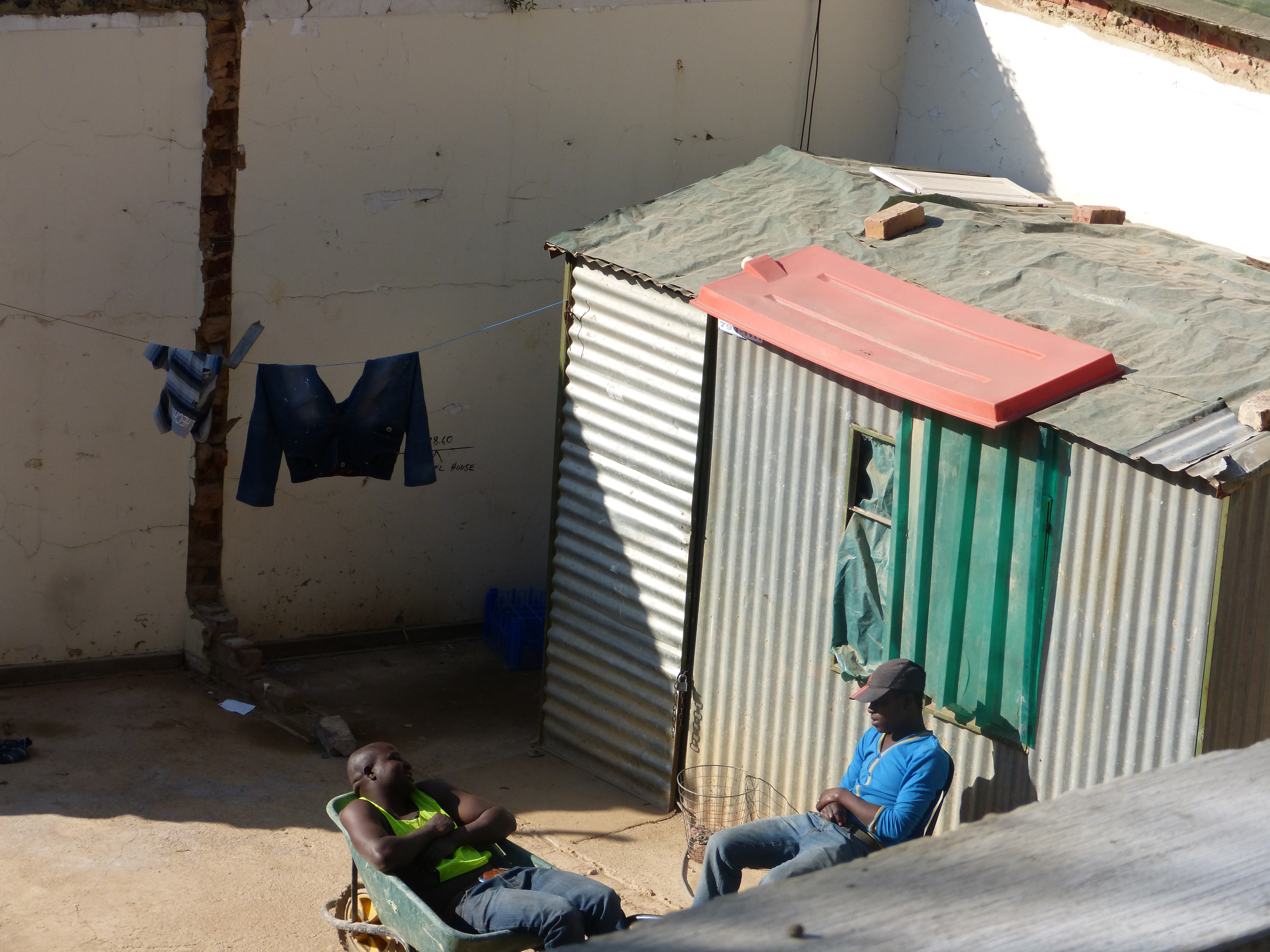
A few of the workmen are living on the site now because of the time it takes them to commute from their homes on a daily basis. I ‘m not entirely comfortable with this.  It’s difficult to accept that their living conditions at home could be such that they are prepared to ‘camp’ on a building site in mid-winter for the sake of saving on travel time – which is the reason given.

Lunch Break -A Wheel barrow is a many-splendoured thing!

Lunch Break

A wheelbarrow, as shown above, is a many-splendoured thing.

July view from main bedroom.

July view from main bedroom.

We are still debating how to ‘finish’ the gaps in the upstairs balcony wall as seen above.  We want the ‘cut-out’ sections for the view they provide but will have to put in either railings or glass panels.  The Jury is still out.

Pyjama Lounge taking shape.

Pyjama Lounge taking shape.


Looking from Bedroom 3 through Bedroom 2.

Looking from Bedroom 3 through Bedroom 2.

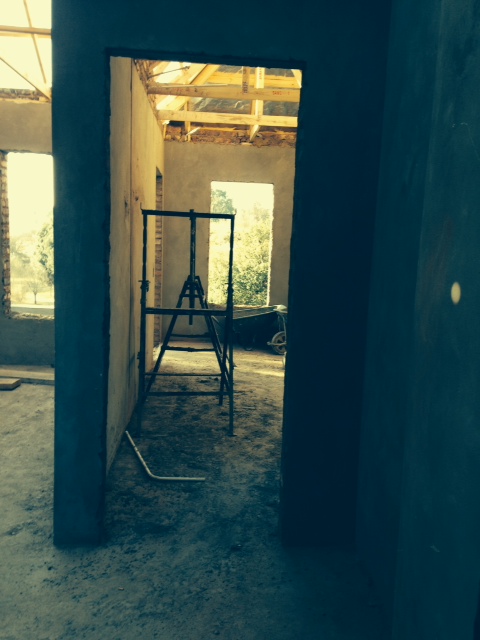
The photo above was taken from the doorway into the third and smallest bedroom, down the short passage (hall) into the second bedroom.  There is a walk-in linen cupboard off to the right and the room glimpsed on the left is the pyjama lounge.

Site Art.

Site Art.


Multi-Tasking.

Multi-Tasking.

It seems that all the workmen on site have cell phones and are adept at using them no matter what else they might be doing. (Research has shown that by December 2013, African mobile (cell) penetration had hit 80% and was growing faster than anywhere else in the world.  According to those statistics more than 8 in 10 Africans have a cell phone.)


More Site Art

And suddenly there was this lovely surprise…. a traditional African pottery bowl.  I’m guessing someone’s mother or wife sent a meal in it.  It was there one day and gone the next.


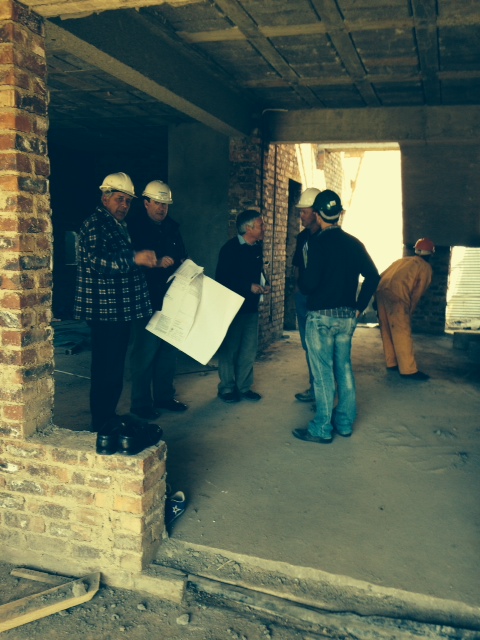
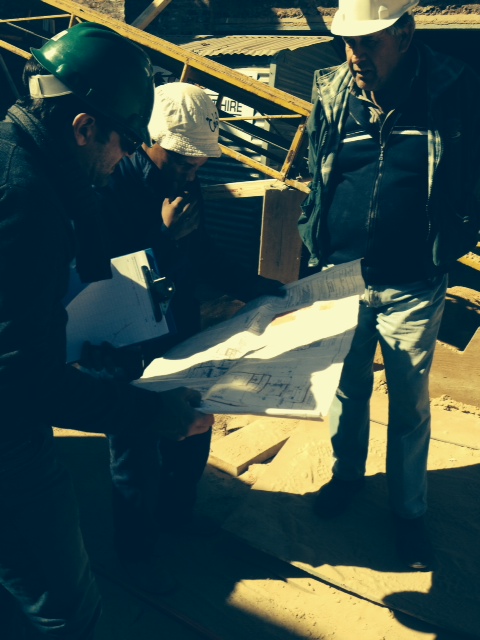
We had a site meeting today:

Site Meeting

Site Meeting

Here are some photographs taken today. We met with two potential swimming pool contractors and Bernard also met with a security consultant to discuss the possibility of installing a roll-down security shutter that will be used to ‘lock off’ the upstairs part of the house at night.  Keeping the upstairs area of a home locked off from the downstairs at night has become something of a norm in this country. This is why many new houses now have an upstairs ‘pyjama lounge’ which is basically a tv/family room where a family can gather late at night even if the rest of the house is ‘alarmed.’   As I write this, I realise it might sound a bit extreme to some people, but this sort of thinking comes completely naturally to us now.

But for now, this is how things looked on site this morning:

Street view taken at an angle through a neighbour's electric fencing.

Street view taken at an angle through a neighbour’s electric fencing.

In the photo above you can see that there is still a lot of activity happening on the roof.  The roof sheeting was delivered this morning.  This was much sooner than we expected but our metal workers’ union, NUMSA, started a major strike yesterday.  The roofing people, with whom we’re very impressed, actually had the foresight to deliver the sheeting today as they suspect there will be huge interruptions to their schedule soon.  It’s unusual for contractors like this to be so proactive.

We think these guys are great.

We think these guys are great.

Kathlego Trusses - Thinking Ahead.

Kathlego Trusses – Thinking Ahead.

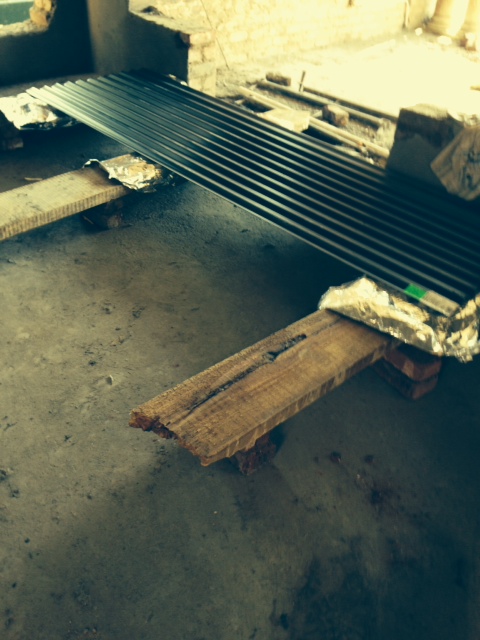
I think it’s been a while since I mentioned the roof.  We have chosen to have an iron roof – traditionally used for farm houses in the past – and have selected a dark grey called Dolphin Grey.  The lighter shades of grey looked almost white in our bright sunshine.  All the colours we considered  vary a lot depending on how light strikes them at any given time.  I’m looking forward to hearing our summer rains beating on these sheets.

Roof Sheeting being stored.

Roof Sheeting being stored.

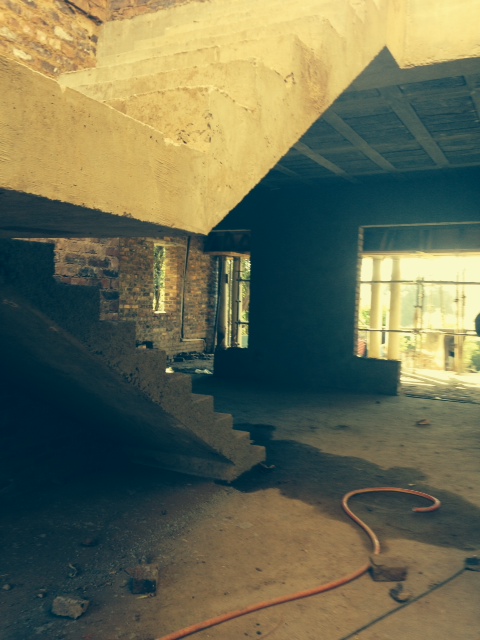
The stairs are occupying my thoughts quite a bit:

The Staircase taken from the front door.

The Staircase taken from the front door.

We wanted the sense of space given by positioning the stairs this way; ie with the lower half flight away from the front door.  It means that the higher flight is ‘free floating’ in that it will need bannisters on both sides.  I’m giving this a lot of thought at the moment along with how I’m going to ‘furnish’ the area below the stairs.  For a while I wondered if my daughter’s baby grand piano would fit but I think it will be a bit cramped.  Until the floors are in and the painting done, it is proving to be quite challenging for me to envisage just how this space will work.

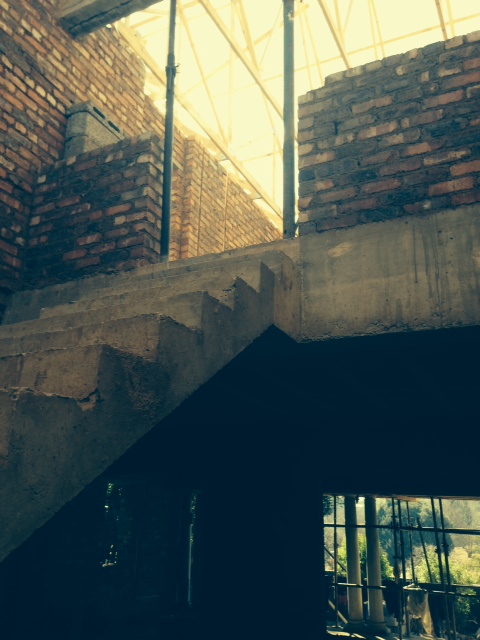
Second flight of stairs.

Second flight of stairs.

The upper flight of stairs opens directly onto the landing/pyjama lounge which faces out over the park.  The walls which you can see in place now are at a height demanded by safety and security laws.  I am still debating lowering them and putting a railing across their top or a glass panel.  It is behind these walls that a security shutter will be lowered at night.

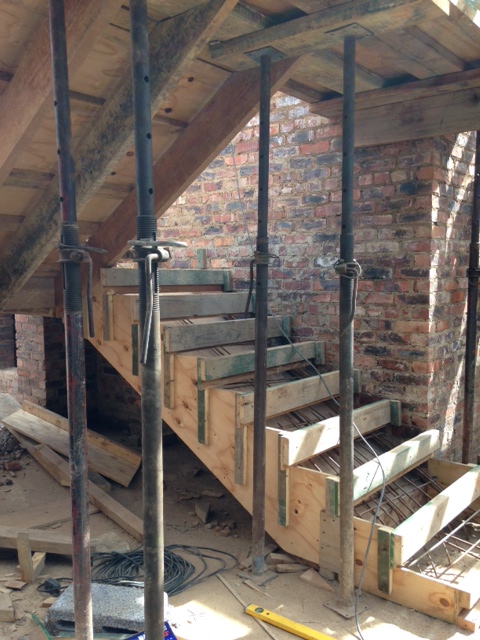
"Archive" photo of stairs from another angle.

“Archive” photo of stairs from another angle.

It much easier now to get an idea of what the covered patio is going to be like.  It is a lovely big space and I think we’ll probably use it more than the indoor living area.  In the picture below you can see a ‘square’ marked off in the ceiling.  This is where a skylight will eventually be installed.

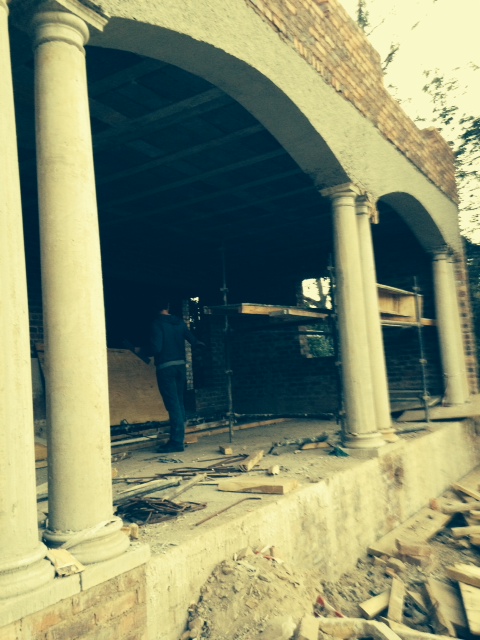
Bernard was funny when we saw the arched openings for the first time.  ‘They look good’, he said, ‘I don’t usually do arches…’  ‘Then why did you agree to have them here??’  ‘Because the house needed them.’ – his response…  And I think he’s right.  The house did need them and I think they frame the view rather well.

Patio Arches

Patio Arches

Arch view

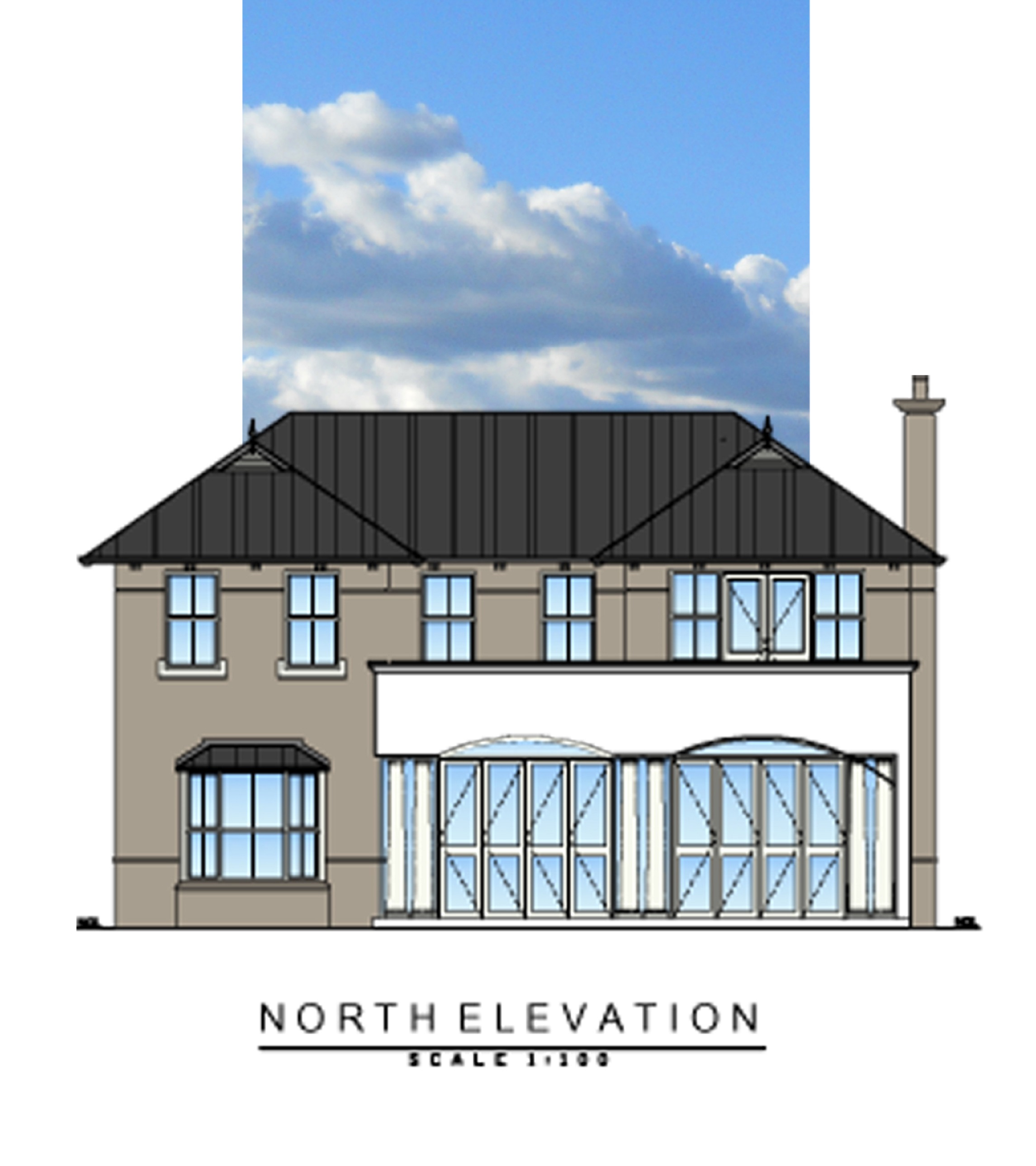
In the elevation which I am posting again below, you can see the design of the patio quite clearly.  It is satisfying to see it taking form now.

The North Elevation is now becoming a reality.

The North Elevation is now becoming a reality.

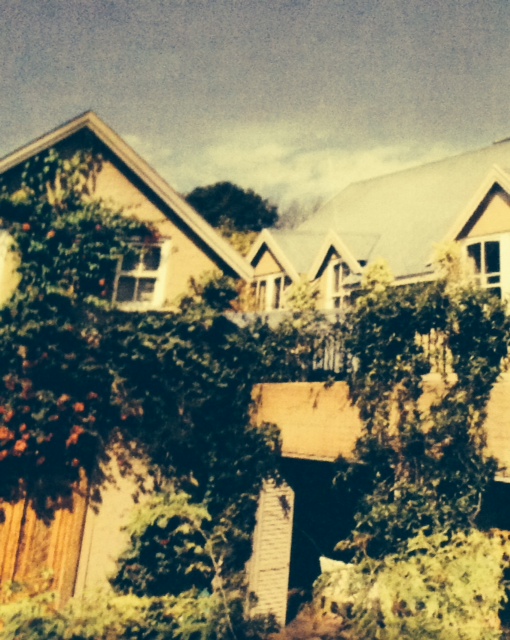
Below is a picture of a ‘contemporary farm house’  under an iron roof similar to the one we’ll be having.

Contemporary Farmhouse with iron roof from which I drew some inspiration.

Contemporary Farmhouse with iron roof from which I drew some inspiration.

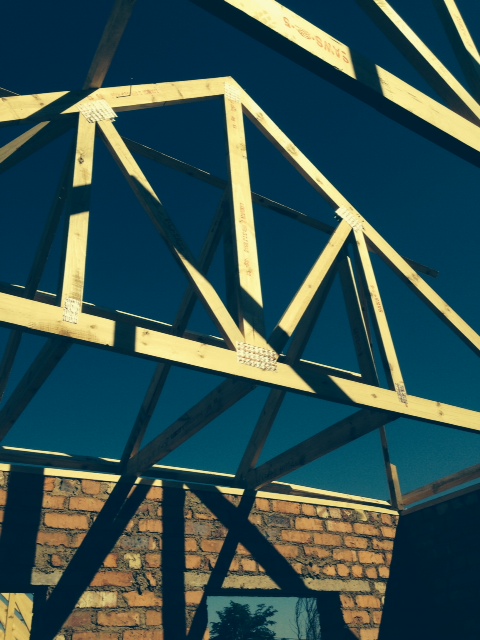
Here are some catch-up photographs from the past couple of weeks.  Most were taken yesterday – Midwinter’s Day – under blazing blue Highveld skies, typical of this time of year.

Rafters against the winter sky.

Rafters against the winter sky.

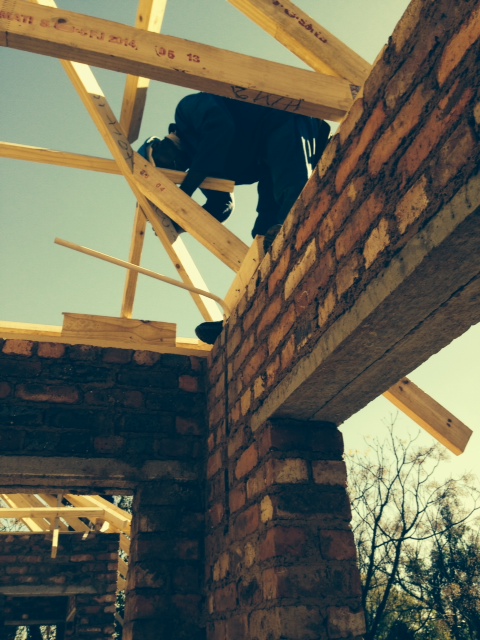
You need a head for heights.

You need a head for heights.


Sure footed roofers.

Sure-footed roofers.

The photo above was taken from the second bedroom – on the east of the house – looking towards the main bedroom which is on the west.  You can seen straight through the openings of what will be two sash windows, opposite each other in the main bedroom; one facing east onto the upstairs balcony and the other facing west.

Rafters over the main bedroom.

Rafters over the main bedroom.

In the photo above you can see the east facing sash window from inside the main bedroom and part of the north facing window.  The rafters in all three bedrooms will be exposed.

House and guest suite over garage, taken from the driveway.

House and guest suite over garage, taken from the driveway.


Bernard and Nigel - current site manager - in discussion with an electrician.

Bernard and Nigel – current site manager – in discussion with an electrician.

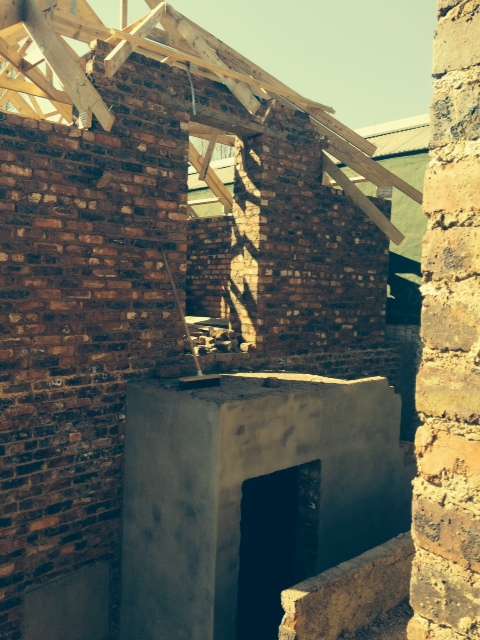
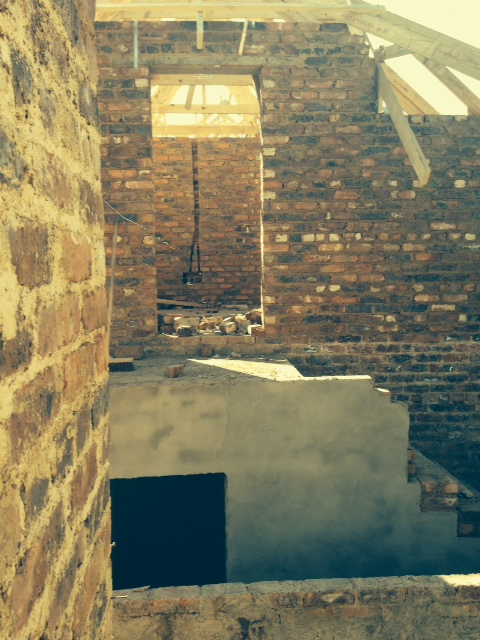
Below is a picture taken from the cottage.  It shows the plastered steps leading up to the door of the guest suite above the garage.  The doorway opening under the steps leads into a washroom for casual workmen.

Steps (plastered) up to guest suite.

Steps (plastered) up to guest suite.

Looking through the door into the guest suite.

Looking through the door into the guest suite.

And below is a view of the north-facing front of the house, as seen from the park.  At last, it is beginning to actually look like a house…


View from the park.

View from the park.


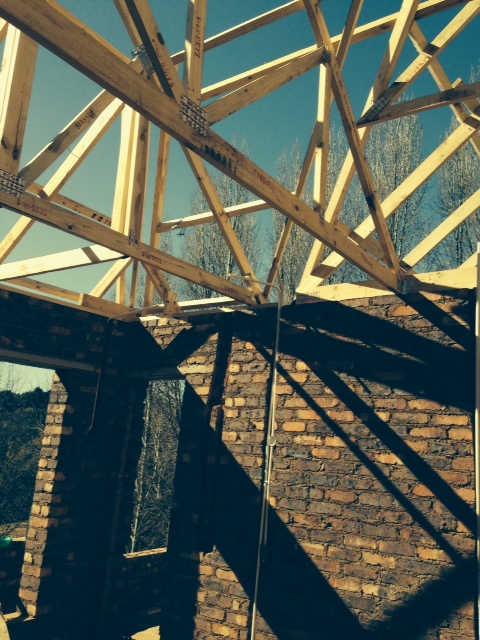
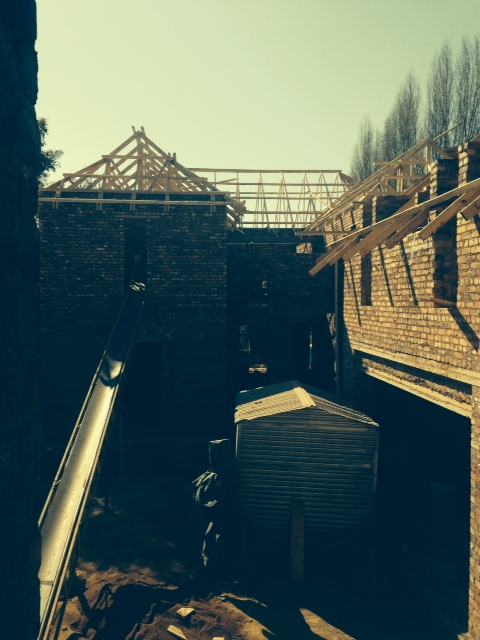
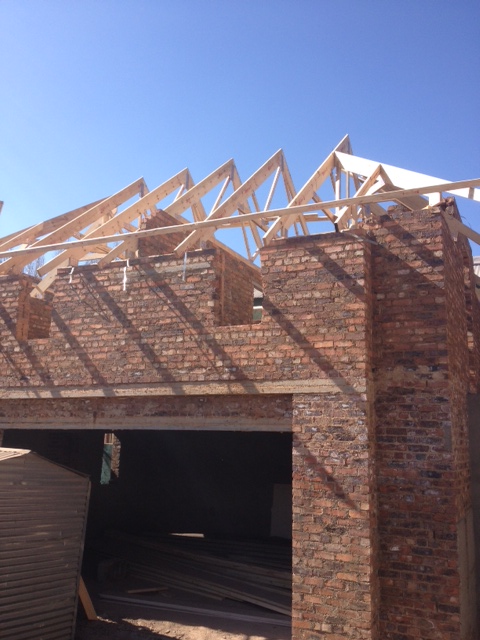
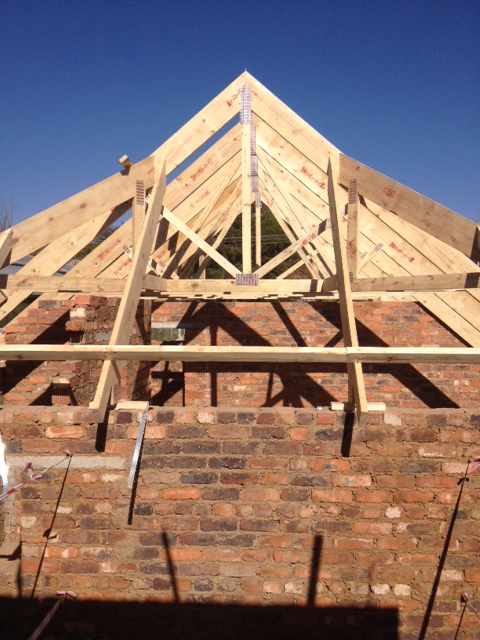
I am in England for a couple of weeks.  Now seemed like a better time to come over than later in the year when I expect the house to become more demanding.  I missed a site meeting this morning and was rewarded with a batch of photographs which included a couple showing the start of the roof construction over the guest suite. It’s great to see it taking shape.

Roof trusses over guest suite above the garage.

Roof trusses over guest suite above the garage.

View of trusses from the south.

View of trusses from the south.


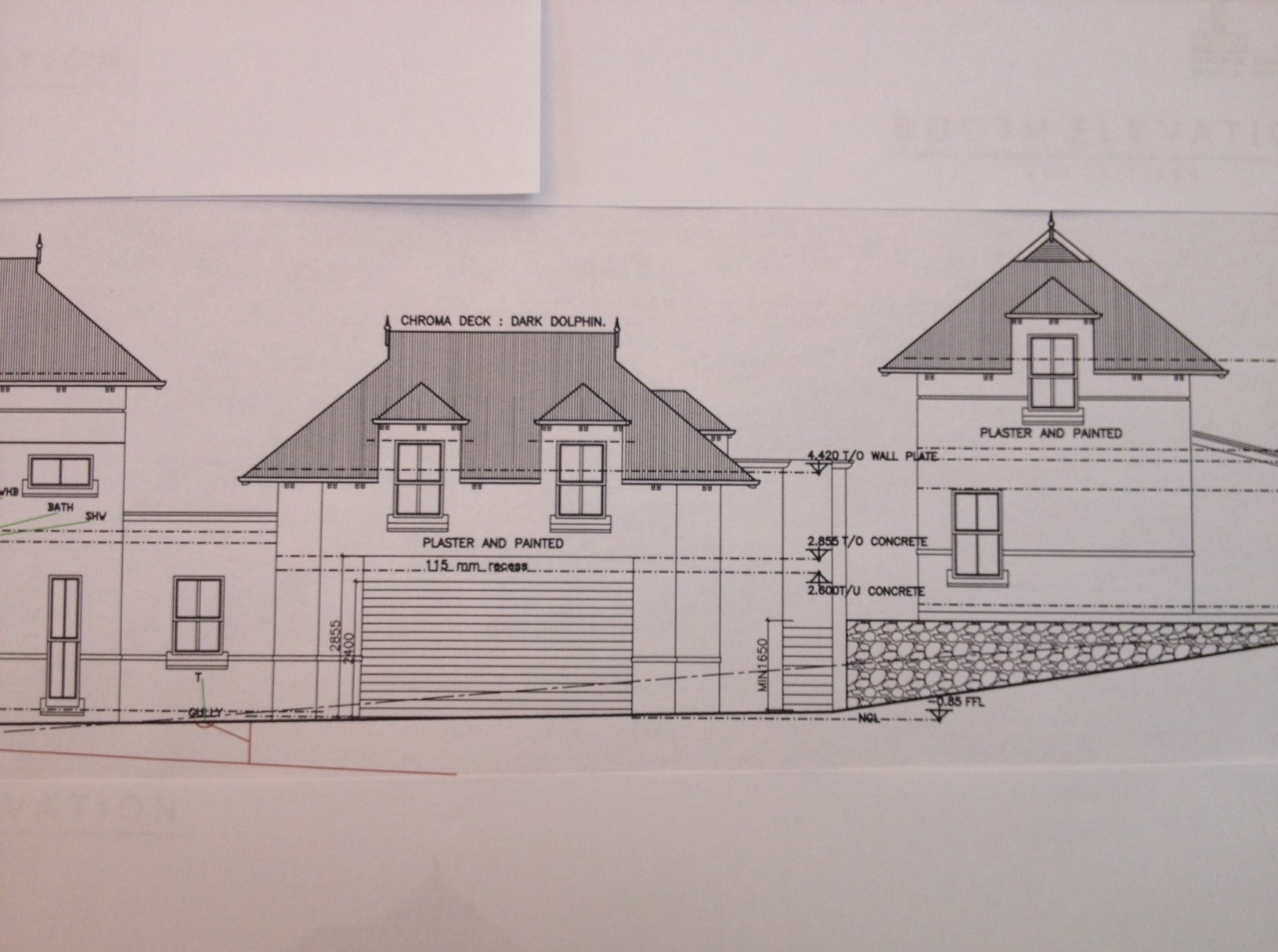
Reminder of what the guest suite will eventually look like.

Reminder of what the guest suite will eventually look like.

Progress seems to have speeded up in my absence.  Perhaps I should make more travel plans…